

A mental offload is what happens when your mind stops being the only place responsible for holding everything.
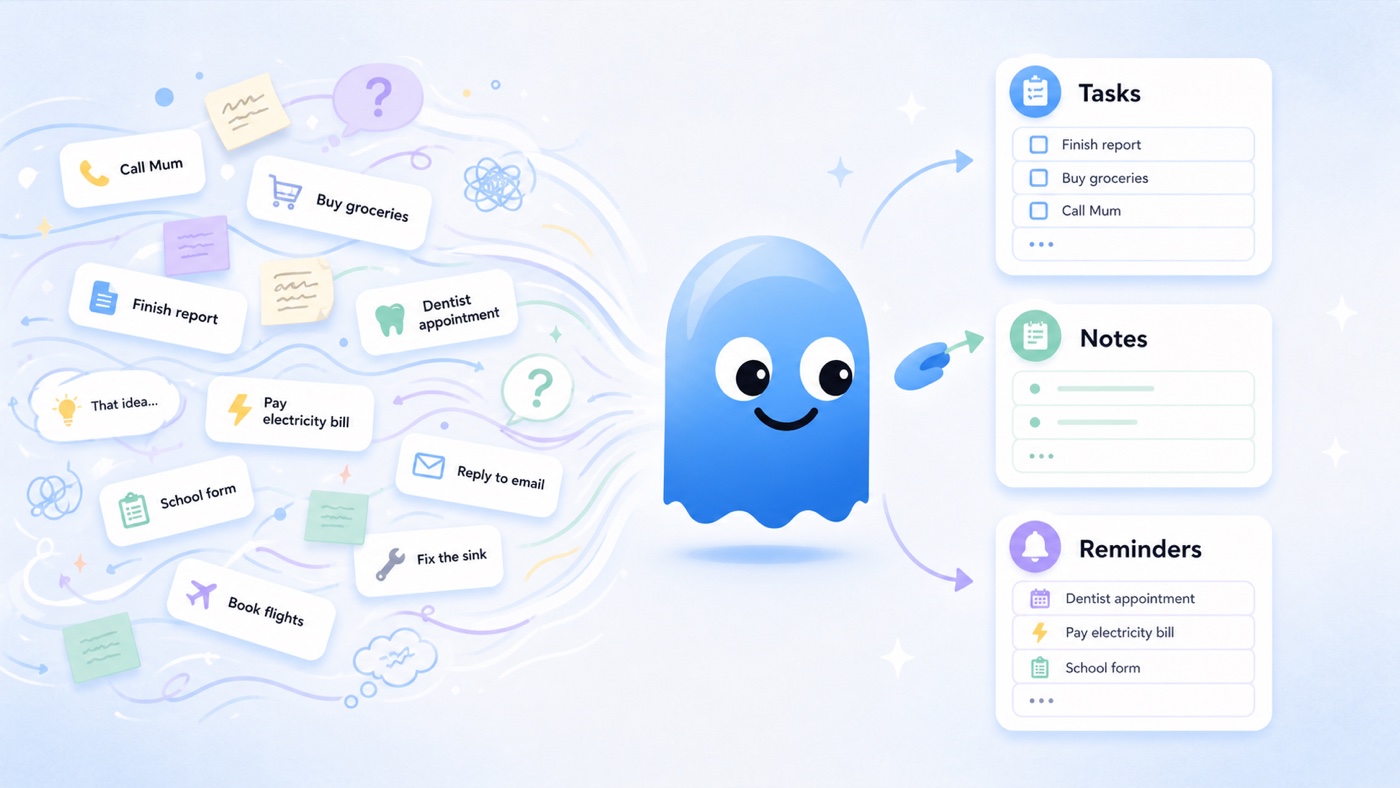
A mental offload means moving tasks, ideas, worries, future intentions, and useful details into an external place you can review. You might use paper, a notes app, a calendar, reminders, or a voice-powered personal assistant such as MyOffload.
The goal is not to empty your mind completely. It is to reduce the amount of information you must keep actively repeating so you do not lose it.
What counts as a mental offload?
A mental offload can be as small as setting an alarm before you forget, or as broad as talking through everything circling in your head at the end of the day.
It may include:
- A task you need to complete
- An idea you do not want to lose
- A promise you made to someone
- A question you cannot solve right now
- A detail you will need in a particular place
- A reminder that must return at the right time
- A worry you want to acknowledge without solving tonight
A brain dump is one kind of mental offload. The useful next step is giving the captured material enough structure that you can find it, act on it, or safely leave it for later.
Why does your brain keep repeating open tasks?
Some thoughts return because they concern a future action: send the document, book the appointment, bring the form, reply after lunch. Psychologists call the ability to remember and carry out a future intention prospective memory.
A vague intention such as “remember the dentist” still asks your mind to decide when it matters. A more useful external cue is “tomorrow at 10, call the dentist after the team meeting.” The task, time, and context are now connected.
Externalizing an intention does not make the task disappear. It changes the job from keep remembering this constantly to respond when the right cue arrives.
What cognitive offloading means in research
Researchers use the broader term cognitive offloading for physical actions that change the information-processing demands of a task. Examples include writing a note, setting a phone reminder, rotating a page, or arranging objects so the environment carries part of the cognitive work.[1]
A recent meta-analysis found that offloading generally improved performance on memory-based tasks. It also reduced some differences in performance between people, with particularly meaningful effects in prospective-memory tasks.[2]
In three experiments, Gilbert and colleagues found that external reminders increased the number of intentions participants remembered, although people sometimes chose reminders even when the reward trade-off made that strategy less than optimal.[3] This is an important distinction: a reminder can improve task performance without proving that it strengthens unaided memory.
Make capture easier than remembering
A system only helps with thoughts that reach it. If capturing a commitment takes too many steps, it is easier to tell yourself, “I will remember later.”
Two preregistered experiments found that people set fewer reminders when reminder-setting required more physical effort. In the low-effort condition, reminders helped participants compensate for higher memory demands.[4]
That research did not compare voice with typing and did not test MyOffload. The reasonable product lesson is narrower: reduce the effort between having a thought and putting it somewhere useful.
With MyOffload, you can tap the microphone and say:
“Tomorrow after the client call, send Maya the revised proposal. Also save the pricing idea I had, and remind me on Friday to check whether she replied.”
Boo, your personal assistant inside MyOffload, keeps the context and sorts the offload into tasks, notes, and requested reminders. You review the result before relying on it.
How to do a three-minute mental offload
- Capture the messy version. Say or write what is circling without trying to organize it first.
- Separate action from information. A task needs an action. An idea or useful detail can remain a note.
- Add a cue where it matters. Give future tasks a time, place, person, or event that will bring them back.
- Review once. Check that important tasks, dates, and names are correct.
- Choose the next review point. Decide when you will look again, then stop repeatedly scanning the list.
The offload does not need to last exactly three minutes. MyOffload offers up to three minutes because that is long enough to say a tangled thought naturally while keeping the ritual small.
What happens after you offload?
Capture is only the beginning. MyOffload is designed to act like a personal assistant for the information you just shared:
- Tasks become reviewable actions
- Ideas and context remain searchable notes
- Requested reminders return at the chosen time
- Break Down turns an overwhelming task into smaller starting steps
- Plan My Day prioritizes and orders today's tasks
- Shared tasks can be assigned to a partner, watched, and nudged without repeating the full conversation
You still review important information and remain responsible for decisions. MyOffload reduces the sorting and remembering work. It does not replace judgment.
Can you rely on offloading too much?
Yes, especially if the external system is unreliable or suddenly unavailable. In two experiments, reminders improved performance for the supported intention, but participants later performed worse on that intention when the reminder was removed than people who had never used the reminder.[5]
Use appropriate backup systems for medication, safety-critical commitments, legal deadlines, travel, finances, or anything with serious consequences. Check that reminders were created correctly. Do not assume that capturing something once guarantees completion.
Questions about mental offloading
Is a mental offload the same as a brain dump?
A brain dump is one kind of mental offload. A useful offload also separates actions from notes, connects future tasks to cues, and gives everything a predictable review point.
Does mental offloading improve memory?
External reminders can improve performance on the tasks they support. That is not the same as strengthening unaided memory. The system must remain reliable, and important commitments need backups.
Can a mental offload help ADHD?
External capture and reminders may support everyday task management for some people with ADHD. A mental offload is not an ADHD treatment and cannot diagnose why someone is forgetful, overwhelmed, or struggling to start.
Can I do a mental offload before bed?
Yes, but keep it light. Capture unfinished tasks and give them a tomorrow cue without turning bedtime into a full planning session. If racing thoughts or sleep problems are persistent or distressing, consider professional support.
The bottom line
A mental offload is not about becoming perfectly organized. It is about giving tasks, ideas, reminders, and unfinished thoughts somewhere more reliable to live.
Capture the messy version, give future actions a useful cue, review once, and let your personal assistant hold the structure while you return to the part only you can do.
Research behind this article
- Risko, E. F., & Gilbert, S. J. (2016). Cognitive Offloading. Trends in Cognitive Sciences.
- Burnett, L. K., & Richmond, L. L. (2026). Meta-analytic investigations of the effect of cognitive offloading on memory-based task performance and interindividual variability. Memory & Cognition.
- Gilbert, S. J., et al. (2020). Optimal use of reminders: Metacognition, effort, and cognitive offloading. Journal of Experimental Psychology: General.
- Chiu, G., & Gilbert, S. J. (2024). Influence of the physical effort of reminder-setting on strategic offloading of delayed intentions. Quarterly Journal of Experimental Psychology.
- Fellers, C., & Storm, B. C. (2026). Offloading reduces prospective memory learning. Journal of Experimental Psychology: Learning, Memory, and Cognition.
Try MyOffload
Give the thought somewhere useful to go
Say the messy version. MyOffload keeps the context and turns the actionable parts into tasks, notes, and requested reminders for you to review.
Download MyOffload for iPhone