

“The moment I lie down, I remember everything I did not finish.”
If your mind becomes louder when the room becomes quiet, you are not alone. Bedtime removes many of the distractions that carried you through the day. Unfinished tasks, conversations, worries, and small commitments can suddenly feel urgent because your brain is still trying to keep them available.
This article offers a short capture ritual for ordinary mental clutter. It is not a treatment for insomnia, anxiety, ADHD, or any other condition.
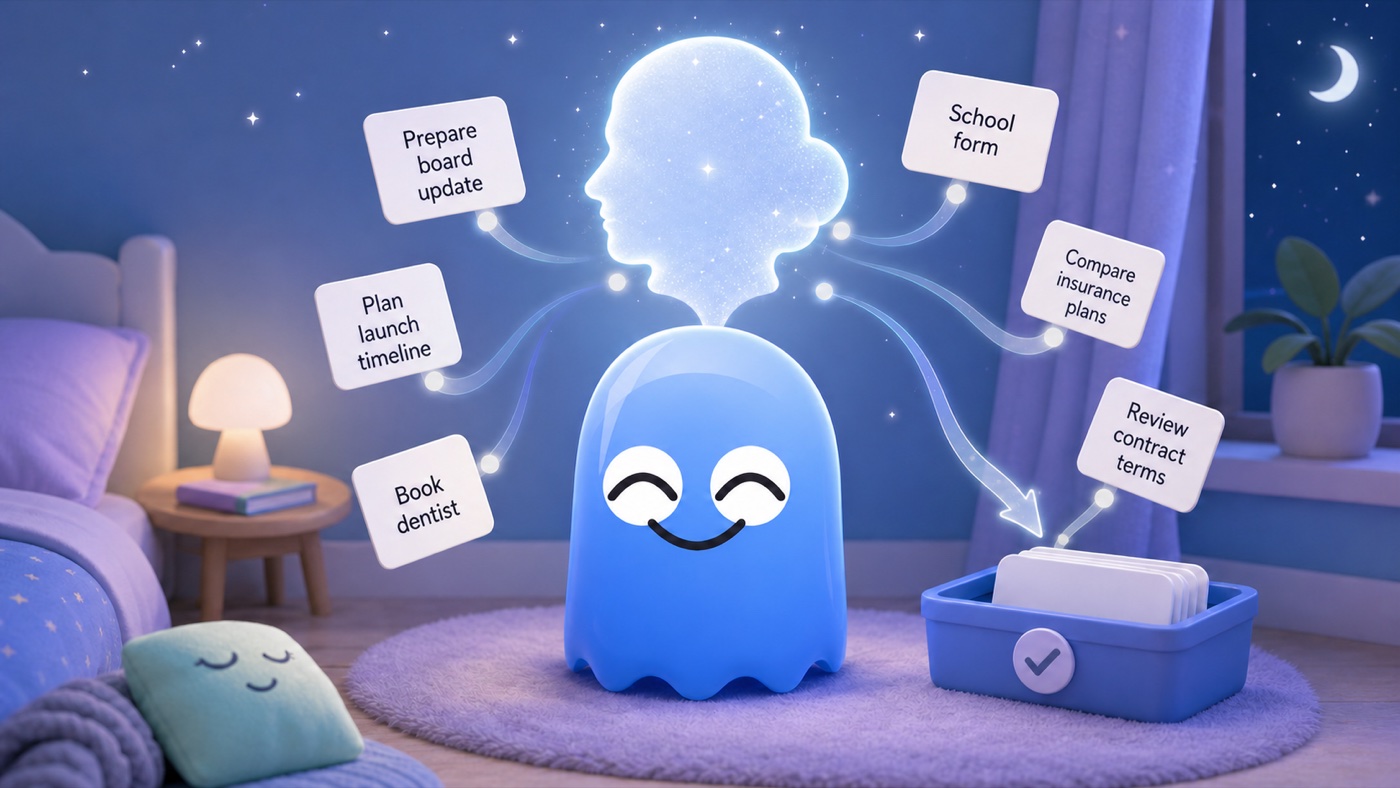
Why unfinished thoughts feel louder at night
Researchers distinguish between worry, which tends to focus on possible future problems, and rumination, which often circles past events or current distress. In real life, the two can blend together.
A systematic review and meta-analysis covering 55 studies found that greater worry and rumination were associated with poorer sleep quality, shorter sleep, and taking longer to fall asleep. The results show an association, not proof that one thought causes one bad night. They do support the experience many people describe: repetitive thinking and sleep difficulty often travel together.
Trying to force your mind completely blank can create another job to fail at. A more realistic goal is to identify what your brain is trying to protect and give it somewhere else to wait. This is one form of a mental offload.
Try a three-minute bedtime offload
Open MyOffload and say everything your brain is trying to hold: unfinished tasks, worries, ideas, things to remember, and conversations you keep replaying. You do not need to organize your thoughts before speaking.
Each offload gives you up to three minutes. Say the whole messy version out loud. MyOffload keeps what you said, turns actionable parts into tasks, and creates reminders when you ask for them. You can review the result once instead of manually rebuilding the brain dump into a perfect system before bed.
Once it is captured, review anything important and let the rest wait until tomorrow. The aim is not to finish planning your life tonight. It is to give your thoughts somewhere reliable to land.
If you prefer paper, keep the exercise short and use three simple groups:
- Tomorrow: something that needs a next action
- Remember: information, an idea, or a commitment worth keeping
- Not tonight: something real that cannot be solved usefully at bedtime
For each Tomorrow item, write only the next visible step. Replace “deal with the school form” with “open the school email after breakfast.” Replace “sort out money” with “check the electricity bill tomorrow at 10.” When using MyOffload, you can say those steps and requested reminder times naturally instead of sorting them by hand.
Then stop. Do not turn the offload into a late-night planning session.
Make tomorrow believable
An offload works better when your brain has a reason to trust it. Give important items a realistic cue:
- “When I finish breakfast, I will open the school email.”
- “At 10 tomorrow, remind me to check the electricity bill.”
- “When I reach my desk, I will send Priya the first line of the email.”
This is sometimes called an implementation intention: linking a situation with a specific action. A meta-analysis of prospective-memory studies found that this kind of if-then planning improved the likelihood of remembering intended actions. It is useful evidence for making reminders concrete, but it does not mean every intention will happen automatically.
MyOffload can turn naturally spoken times into reminders, but review anything important. Do not rely on an app alone for medical, emergency, safety-critical, or legally significant reminders.
What the bedtime-writing study actually found
One frequently cited laboratory study randomly assigned 57 healthy adults aged 18 to 30 to spend five minutes writing either a future to-do list or a list of completed activities. The to-do-list group fell asleep faster during that single laboratory night, and more specific lists were associated with faster sleep onset.
That is encouraging, but narrow evidence. It was a small study, involved young adults, and observed one night in a sleep laboratory. It does not show that writing a list treats chronic insomnia or guarantees better sleep.
The practical takeaway is modest: if unfinished tasks are keeping you mentally on call, a brief, specific capture may be worth trying. The study used a five-minute writing exercise; it did not test whether five minutes is the ideal duration or whether a three-minute voice offload produces the same result.
Give the day a closing sentence
After your offload, choose one sentence that signals completion:
It is captured. I do not have to keep rehearsing it tonight.
Then put the notebook or phone down. The goal is not a perfectly empty mind. It is a mind that no longer has to be the only place holding tomorrow.
When an offload is not enough
If sleep difficulty is persistent, causes substantial distress, affects your daytime functioning, or comes with major changes in mood, energy, or behaviour, consider speaking with a qualified clinician. Cognitive behavioural therapy for insomnia has an evidence base and is more than a bedtime list. A systematic review found that CBT-I can reduce sleep-related worry, while effects on broader rumination were smaller and less certain.
Seek immediate local emergency or crisis support if you feel unsafe or might harm yourself or someone else.
Where MyOffload fits
MyOffload is designed for the unpolished moment: “I need to email Priya, pay the bill, remember the school form, and I cannot deal with the presentation tonight.” Say it once. MyOffload preserves the thought and sorts the useful parts into notes, tasks, and requested reminders for you to review.
You do not need to prioritize the whole list at bedtime. The next day, use Break Down if a task is too large and tap Plan My Day if you want MyOffload to order the day for you.
That does not make MyOffload a sleep treatment. It makes it a calmer place for the responsibilities your brain is trying not to lose.
The bottom line
You do not need to empty your mind by force. Give unfinished tasks a trusted place, make tomorrow’s first step specific, name what cannot be solved tonight, and stop once the offload is captured.
Sometimes “switching off” begins with asking your brain to remember less.
Research behind this article
- Clancy, F., et al. (2020). The association between worry and rumination with sleep in non-clinical populations: a systematic review and meta-analysis. Health Psychology Review.
- Scullin, M. K., et al. (2018). The effects of bedtime writing on difficulty falling asleep: A polysomnographic study comparing to-do lists and completed activity lists. Journal of Experimental Psychology: General.
- Ballesio, A., et al. (2021). Does cognitive behaviour therapy for insomnia reduce repetitive negative thinking and sleep-related worry beliefs? A systematic review and meta-analysis. Sleep Medicine Reviews.
- Chen, X.-J., et al. (2015). The effect of implementation intention on prospective memory: a systematic and meta-analytic review. Psychiatry Research.
Try MyOffload
Give the thought somewhere useful to go
Say the messy version. MyOffload keeps the context and turns the actionable parts into tasks, notes, and requested reminders for you to review.
Download MyOffload for iPhone