

“There is so much to deal with that even making a list feels like another thing I cannot do.”
When work, money, family, messages, appointments, and worries arrive together, a detailed productivity system can feel like one more demand.
You do not need to organize your whole life right now. A mental offload starts by moving the pile out of your head before asking you to organize it.
The shortest version
If you are too overwhelmed to read the whole article, do this:
- Open MyOffload.
- Say the messy version for up to three minutes.
- Review the tasks, notes, and requested reminders it created.
That is enough. You do not need to create categories or sort the thought yourself.
If you are not using MyOffload, there is a simple paper method below.
Why everything can feel equally urgent
When many unfinished demands remain in your head, they can blur into one large alarm. A school form, a difficult conversation, a bill, and a long-term project can all feel as though they need attention now.
An external record can carry some of that memory work. Researchers call this broader idea cognitive offloading: using something outside your mind to reduce the internal demands of remembering or processing. A recent meta-analysis found that offloading improved performance on memory-based tasks on average.
That does not mean an app or list resolves emotional distress. It supports a narrower idea: your brain does not have to be the only place holding everything.
With MyOffload: speak first and sort nothing
Tell MyOffload what is happening in the way it actually arrives:
“I need to finish the client update, the electricity bill is due, I have not replied to Mum, and I think there is something for school tomorrow.”
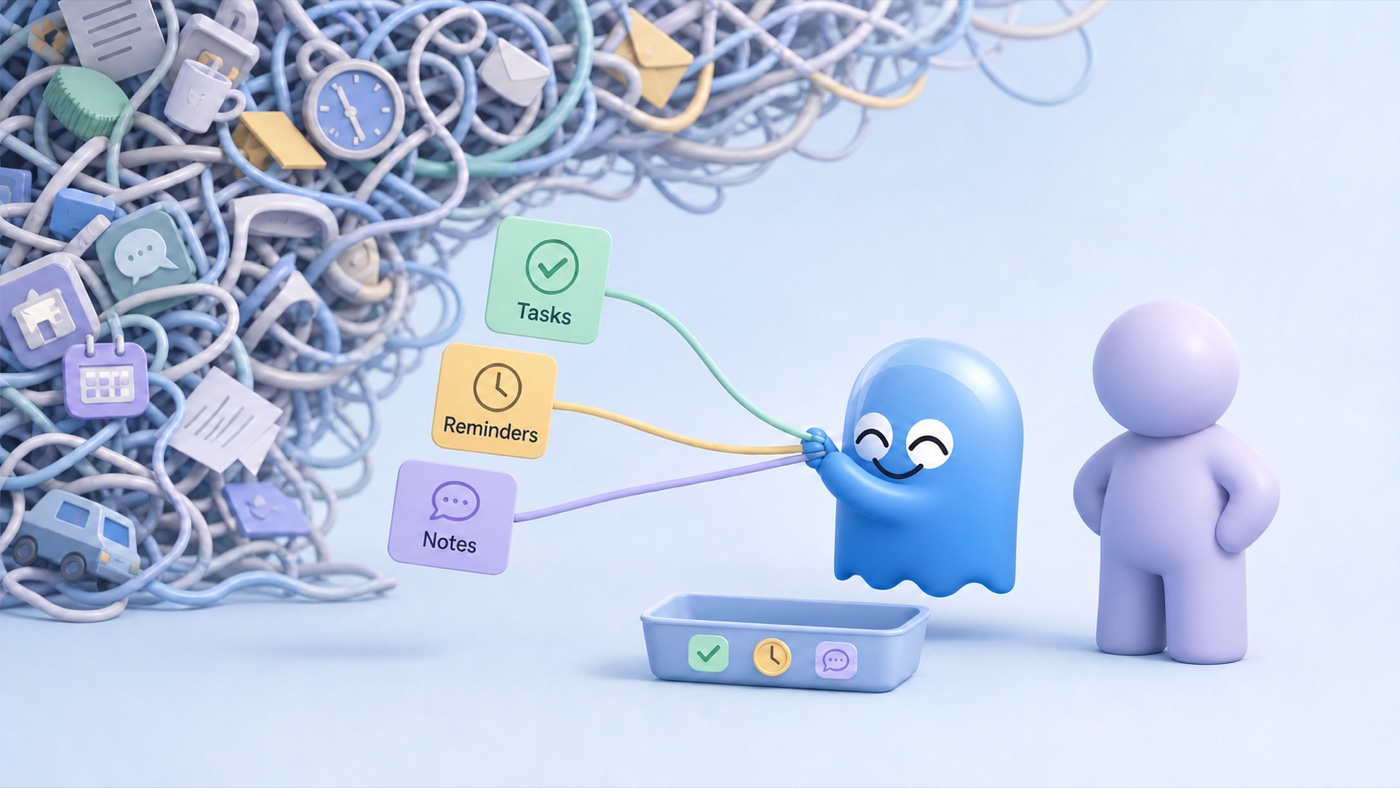
MyOffload keeps the full thought, pulls out clear actions, and creates reminders when you ask for them. You review the result once instead of rebuilding the brain dump by hand.
You do not need to decide whether each sentence belongs under Today, Can wait, or Ask for help before speaking. Those headings are only a paper fallback, not extra work inside the app.
Review anything important. MyOffload can reduce the sorting burden, but it cannot decide what is safest or most important in every situation.
If you are using paper, make only three headings
No MyOffload right now? Write everything down, then use:
- Today: one thing that genuinely needs attention
- Can wait: important, but not for this moment
- Ask for help: something another person or professional may need to share
This is not a complete plan. That is the point.
Let MyOffload find the actions; choose one only if you can
After MyOffload separates the actionable parts, glance at the result. If you have capacity for one step, choose the smallest useful action:
- “Pay bills” becomes “open the electricity bill.”
- “Fix work problem” becomes “send Sam the two-sentence update.”
- “Deal with school” becomes “open the school email.”
- “Get help” becomes “text Maya: Can you talk for ten minutes?”
You are not manually rewriting the whole list. You are choosing where to begin from the tasks MyOffload has already identified.
If a task is still too large, tap Break Down to make the first steps smaller. If the whole day feels crowded and you have the capacity, tap Plan My Day. MyOffload can prioritize and order the tasks for you, while keeping timed work in place.
If even one action is too much, stop after capturing. Getting the load out of your head still counts.
Asking for help counts as an action
Some loads are shared, specialised, or simply too heavy for one person. Asking for help might mean:
- asking a partner to own the school form completely
- telling a manager that two deadlines conflict
- contacting a doctor about persistent symptoms
- asking a friend to sit with you during one difficult call
- contacting a qualified mental-health professional when distress is not easing
The first step can simply be telling the right person what is happening.
What research can and cannot tell us
Evidence on cognitive offloading supports external tools for memory-based demands. Research also supports behavioural activation as a structured treatment for depression, but choosing one small action here is not behavioural activation therapy.
No study proves that MyOffload or a three-heading paper list will fix overwhelm. The practical value is smaller and more honest: capture reduces what you must keep rehearsing, and one visible next step can reduce the decisions required to begin.
When “too much” means you need immediate support
If “life feels like too much” means you feel unsafe, might harm yourself or someone else, cannot care for your immediate basic needs, or are in danger, do not rely on a productivity exercise or app. Contact local emergency services, a crisis line, or a trusted person who can stay with you while you get immediate help.
If the feeling is persistent or substantially affecting daily life, consider speaking with a qualified clinician. You deserve support that matches the seriousness of what you are carrying.
The bottom line
With MyOffload, the bare-minimum system is simple: speak once, review once, and let the app make the next step easier to see.
No categories are required. If you have the capacity, break down one task or plan the day in one tap. If you do not, stopping after capture still counts.
Research behind this article
- Burnett, L. K., & Richmond, L. L. (2026). Meta-analytic investigations of the effect of cognitive offloading on memory-based task performance and interindividual variability. Memory & Cognition.
- Uphoff, E., et al. (2020). Behavioural activation therapy for depression in adults. Cochrane Database of Systematic Reviews.
- Ciharova, M., et al. (2021). Cognitive restructuring, behavioral activation and cognitive-behavioral therapy in the treatment of adult depression: A network meta-analysis. Journal of Consulting and Clinical Psychology.
Try MyOffload
Give the thought somewhere useful to go
Say the messy version. MyOffload keeps the context and turns the actionable parts into tasks, notes, and requested reminders for you to review.
Download MyOffload for iPhone