

“I cannot name what I forgot, but I keep feeling that I forgot something.”
That background alarm can follow you through a normal day: leaving home, finishing work, trying to relax, or getting into bed. There may be a specific commitment hiding underneath it. There may also be several vague intentions competing for attention.
There is no single explanation for feeling forgetful. Stress, sleep, mood, attention, medication, health conditions, life transitions, and ordinary limits of memory can all matter. An article cannot tell you which applies.
If you keep thinking, “I forgot something,” the feeling may be an unfinished intention rather than a missing memory you can immediately retrieve. Turn the vague alarm into a short check for promises, dates, people waiting on you, and things needed at a specific time or place.
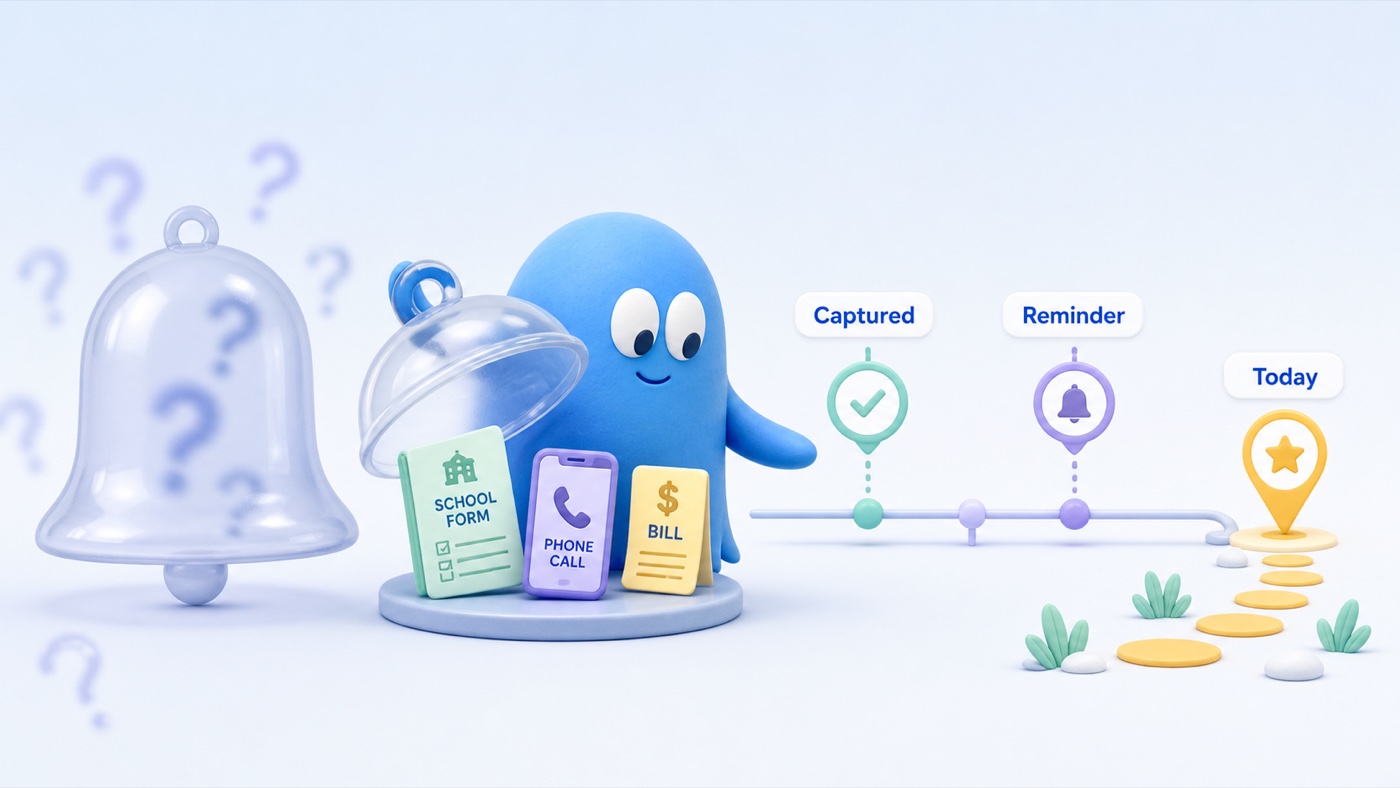
Future intentions are a special kind of memory
Remembering to do something later is called prospective memory. It includes intentions such as calling someone after work, bringing a form to school, or paying a bill on Friday.
These tasks are difficult because the intention must return at the right moment. “Remember the dentist” is less useful than “When lunch ends, call the dentist.” A cue gives the intention somewhere to reconnect with your day.
Build a trusted capture loop
Use one place for incoming commitments. The exact tool matters less than whether you actually use and review it.
MyOffload is designed for low-friction capture: say the commitment when it appears, keep the surrounding context, and let the app create the task and requested reminder for you to review. For example:
I promised to send Arjun the file after lunch tomorrow. Remind me at 2.
Review the result, then let the system hold it. For safety-critical or high-consequence commitments, use appropriate backup systems and never rely on one notification.
When several captured tasks belong to today, Plan My Day can prioritize and order them in one tap. That helps the reminder system lead to a clear day instead of another list you have to keep scanning.
Run a two-minute closure check
If you are wondering, “Am I forgetting something?”, do not search your entire life. Check the places where future commitments usually hide.
At the end of a work block or day, ask:
- Did I promise anything during a conversation?
- Did I receive a date, deadline, or form?
- Is someone waiting for me?
- Did I have an idea I am afraid to lose?
- Is there anything I need in a particular place or time?
Capture the answers. Then choose one next review time. Constantly checking the list can become another source of tension; trust comes from a predictable review, not endless scanning.
If this process helps, the broader practice is called a mental offload: moving tasks, worries, ideas, and future intentions into an external place you can review.
Why the feeling shows up at the door, in the car, and in bed
Notice when the alarm tends to ring. For most people it is not random. It arrives at transitions: locking the front door, pulling out of the car park, closing the laptop, turning off the light.
Transitions are when the context changes, and a lot of what you need to remember is tied to context. Keys, forms, and chargers belong to the house. Promises belong to the conversation you just left. Tomorrow's first task belongs to the desk you are walking away from. When you leave the place, your mind does a quick sweep for anything that depended on being there. If it cannot finish the sweep, you get the vague feeling instead of a specific answer.
The practical move is to give each transition its own five-second check rather than carrying one general worry all day.
- Leaving home: keys, wallet, phone, anything for a specific appointment today.
- Ending work: did I promise anything, and what is the first thing tomorrow?
- Getting into bed: is anyone waiting on me, and is anything due before noon?
If you already use MyOffload, this is where a spoken reminder tied to a moment does the work for you. “Remind me at 8 tomorrow to take the signed form” is a cue that meets you at the transition instead of hoping you remember to check.
Turn “remember X” into a cue you will actually meet
Most intentions fail at the wording stage. “Remember to call the clinic” has no time, no trigger, and no first action, so it floats. Rewriting it takes ten seconds and removes most of the background alarm.
Pair each intention with one of three cues:
- A time: “Call the clinic at 11:15 after the standup.”
- A place: “When I get to the pharmacy, ask about the refill.”
- A person or event: “When Arjun messages, send him the file.”
Then say it the way you would say it to a friend. In MyOffload that might be:
Tomorrow when I finish the standup, call the clinic about the referral. Remind me at 11:15.
The app keeps the sentence, creates the task, and sets the reminder you asked for. You review it once and stop carrying it. If the same intention keeps coming back, that usually means the cue was wrong, not that your memory is broken. Try a different trigger.
If you have ADHD
Difficulty remembering intentions, rather than facts, is one of the most common things people with ADHD describe. You know exactly what you were supposed to do. The problem is that the intention did not resurface at the right moment.
External cues help here more than trying harder does. Two adjustments make the approach in this article fit better:
- Capture the moment the intention appears, even mid-sentence. If you wait for a tidier moment, it may not come back.
- Attach every intention to a time, place, or person. Vague reminders that fire “sometime today” are easy to dismiss and easy to forget again.
None of this is a treatment for ADHD, and a reminder app cannot evaluate attention or memory symptoms. It is a way to reduce how much you have to hold in working memory while you and your clinician handle the rest.
A ten-minute weekly sweep
Daily checks catch today's promises. A short weekly review catches the slow-moving ones: renewals, forms, follow-ups, and the things you told someone you would “get to.”
Once a week, look at:
- The next seven days on the calendar, and what each event needs from you beforehand.
- Anything you are waiting on from someone else, and whether it needs a nudge.
- Money and admin: bills, renewals, forms, appointments to book.
- Home and family: school dates, gifts, repairs, medication refills.
- Ideas you saved and want to revisit.
Capture anything that turns up, give it a cue, and close the review. If you use MyOffload, saying the whole sweep out loud in one voice note is enough. The tasks land as tasks, the ideas stay as notes, and Plan My Day can order the ones that belong to tomorrow.
The goal is not a perfect system. It is a review that happens often enough that your mind can stop running its own version in the background.
What research says about external reminders
A meta-analysis found benefits from cognitive offloading on memory-based tasks, with particularly notable reductions in performance differences for prospective-memory tasks. Another meta-analysis found medium improvements in prospective memory from implementation intentions.
The evidence supports external cues as useful tools. It does not mean reminders improve the underlying ability to remember everything. Recent experiments also suggest that performance can drop when a reminder people relied on is removed. The practical lesson is to use external systems intentionally and keep important backups.
When to seek medical advice
Talk with a healthcare professional if memory changes are sudden, clearly worsening, causing safety problems, or interfering with daily activities such as managing medication, money, driving, following familiar directions, or caring for yourself. Confusion, getting lost in familiar places, repeated questions, major behavioural changes, or symptoms following a head injury deserve prompt attention.
The U.S. National Institute on Aging notes that memory problems can have many possible causes, including medication effects, sleep problems, depression or anxiety, nutritional issues, infections, and other medical conditions. Some causes are treatable, which is why evaluation matters.
MyOffload can help manage commitments. It cannot evaluate memory symptoms or replace medical advice.
Questions about that “I forgot something” feeling
Why do I always feel like I forgot something?
The feeling can come from an unfinished future intention that has not been connected to a clear cue. Stress, sleep, mood, attention, medication, health conditions, and ordinary limits of memory can also contribute.
What should I do when I think I forgot something?
Run a short closure check for promises, dates, people waiting on you, items needed in a particular place, and ideas you wanted to save. Capture any answer in one trusted system and choose the next time you will review it.
Can anxiety make me feel like I am forgetting something?
Anxiety can increase checking and make uncertainty feel urgent, but an article cannot determine why you feel forgetful. Seek medical advice for sudden, worsening, unsafe, or functionally disruptive memory changes.
Why do I feel like I forgot something when I leave the house?
Leaving is a transition, and transitions are when your mind sweeps for anything that depends on where you are. A five-second check at the door, or a reminder tied to leaving, usually settles it faster than searching your whole day.
Is feeling like you forgot something a sign of ADHD?
Difficulty remembering intentions is commonly reported by people with ADHD, but the feeling on its own is not a sign of any condition. Stress, poor sleep, and a busy week can produce it in anyone. If forgetfulness is persistent, started early in life, and affects work, relationships, or safety, a qualified professional can evaluate it properly.
The bottom line
Make intentions specific, capture them when they appear, connect important tasks to a cue, and let one trusted system bring today into order.
If the feeling persists despite a reliable system, or the changes are concerning, bring the concern to a qualified professional rather than trying to productivity-hack around it.
Research and guidance behind this article
- Burnett, L. K., & Richmond, L. L. (2026). Meta-analytic investigations of the effect of cognitive offloading on memory-based task performance and interindividual variability. Memory & Cognition.
- Chen, X.-J., et al. (2015). The effect of implementation intention on prospective memory: a systematic and meta-analytic review. Psychiatry Research.
- Fellers, C., & Storm, B. C. (2026). Offloading reduces prospective memory learning. Journal of Experimental Psychology: Learning, Memory, and Cognition.
- National Institute on Aging. Memory Problems, Forgetfulness, and Aging.
Try MyOffload
Give the thought somewhere useful to go
Say the messy version. MyOffload keeps the context and turns the actionable parts into tasks, notes, and requested reminders for you to review.
Download MyOffload for iPhone