

Bedtime is not always quiet.
One person suddenly remembers the appointment.
The other remembers the parcel, the electricity bill, the renewal email, the call, and the thing they were supposed to tell their partner three days ago.
Now both people are trying to sleep while tomorrow is being planned from the pillow.
The short answer
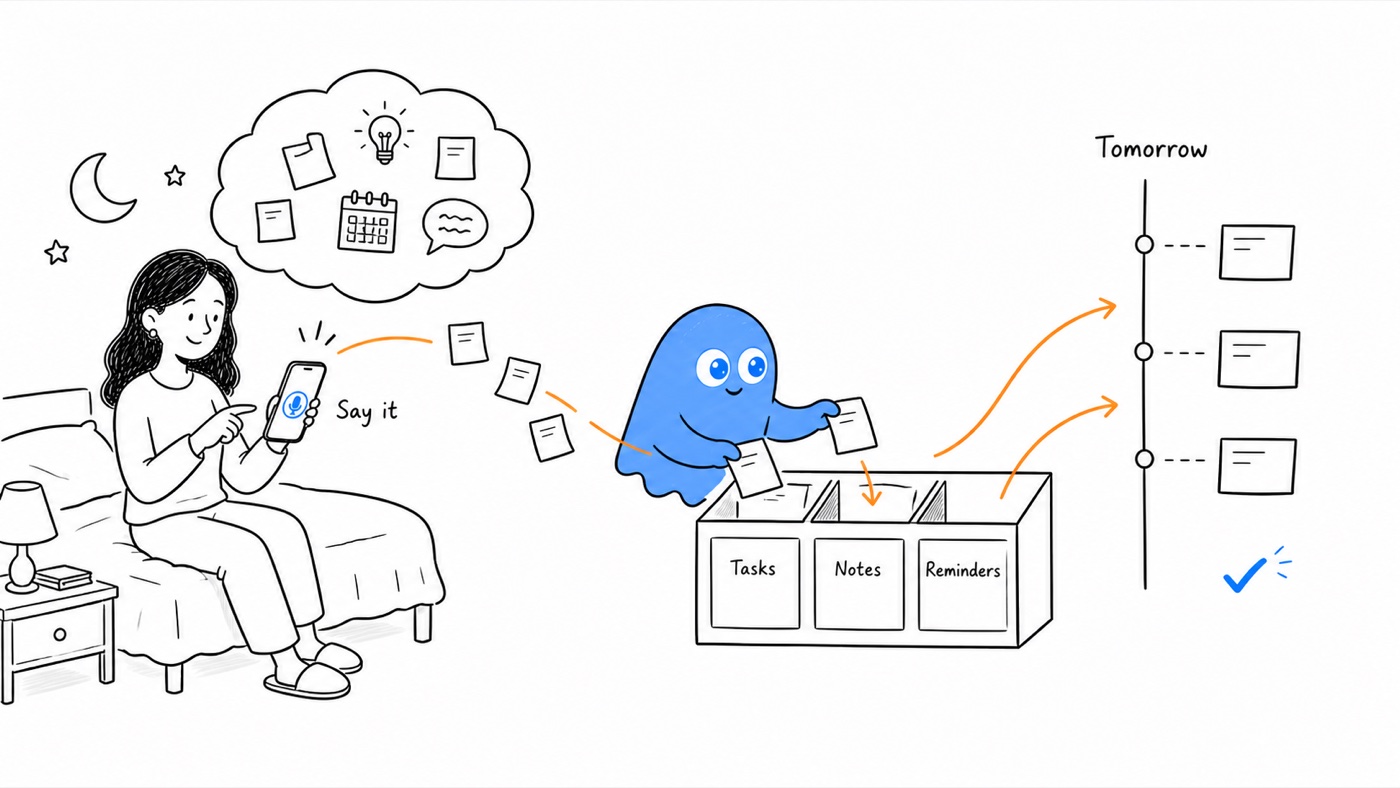
A three-minute evening offload is a short voice ritual where each partner says the unfinished tasks, reminders, notes, and shared responsibilities still occupying their mind.
In the MyOffload app, each spoken offload can last up to three minutes. The app keeps the context and sorts useful parts into tasks, notes, dates, and requested reminders for review.
This is not a relationship meeting and not a promise to empty every thought. It is a simple handoff from working memory to a system you can check tomorrow.
What the ritual sounds like
Sneha opens the MyOffload app, taps the mic, and says:
Tomorrow I need to review the onboarding copy and send the payment screenshot to the accountant. Remind me after lunch to call the clinic. Save that Ari preferred the mushroom pasta at the restaurant. Remind Ari Thursday evening to upload the apartment lease renewal documents before Friday.
MyOffload separates the useful pieces for review.
Ari does their own offload:
Finish the dashboard before Thursday. Tomorrow start with the export bug. Remind me at 5:30 pm to pick up the prescription. Add Sneha as a watcher on the travel insurance task.
Neither partner has to convert the thoughts into perfect categories before speaking.
Why three minutes can be enough
The ritual is deliberately contained.
It gives the mind permission to say the messy version without turning bedtime into an hour of planning.
Three minutes is a MyOffload product limit and a practical design choice. It is not a scientifically proven ideal duration.
One small laboratory study randomly assigned 57 healthy young adults to write either a future to-do list or a completed-activities list for five minutes before sleep. The future to-do group fell asleep faster in that controlled setting. The study was small, did not test voice capture, did not involve ADHD couples, and does not prove that an evening offload treats insomnia. Read the study
The reasonable takeaway is not “three minutes will make you sleep.”
It is that putting specific future tasks into an external form may be a useful bedtime practice for some people.
ADHD and sleep need careful language
Adults with ADHD frequently report sleep difficulties, but the relationship is complex.
A systematic review and meta-analysis found differences in several subjective sleep measures and some actigraphy measures between adults with and without ADHD. It also found no significant differences in the polysomnographic parameters assessed and called for more research. Read the review
Racing thoughts at bedtime can also be related to anxiety, stress, insomnia, depression, trauma, medication, substance use, life circumstances, or other factors.
An evening offload is an organization ritual, not a diagnosis or treatment.
Keep personal offloads personal by default
Each partner should have space to capture their own thoughts without automatically sharing everything.
Share only what needs shared ownership or visibility.
For example:
- a jointly paid bill
- a travel deadline
- a household supply
- a task one partner assigned to the other with consent
- something where one person needs watcher visibility
A private work idea, personal note, or unrelated task does not need to appear on the Shared screen.
The relationship should have a shared system, not shared access to every thought.
A simple three-minute sequence
You do not need a timer. MyOffload already gives each spoken offload up to three minutes.
First minute: what is unfinished?
Say tasks, promises, follow-ups, and open loops.
Submit the proposal. Replace the passport photo. Reply to Maya.
Second minute: when does anything need to return?
Add dates, moments, or triggers where they matter.
Remind me Tuesday at lunch. This needs to happen after Maya replies. Pick it up on the way home Friday.
Third minute: what belongs to someone else or needs shared visibility?
Name the owner and watcher only for genuinely shared items.
Assign the lease renewal documents to Ari for Thursday. Add Sneha as a watcher on the travel insurance task.
You do not have to follow this order perfectly. The point is to speak naturally while enough context is still available.
Review, then stop planning
After the offload, review anything important:
- names
- dates
- recurrence
- task owner
- reminder time
- watcher access
- information that affects health, money, travel, or another person
Then stop.
Do not turn the ritual into a full nightly productivity review.
If a task is large, use the Break Down button tomorrow when you are ready to work. When you are planning the day, use the Plan My Day button to prioritize and order the tasks while keeping timed commitments in place.
Bedtime capture and daytime planning are different jobs.
If your main difficulty is remembering an intention at the right moment, read Why Do I Remember a Task but Still Forget to Do It?. If a shared reminder is causing tension, read How Couples Can Share Reminders Without Nagging.
Do not use the ritual to assign surprise work
Partner sharing requires agreement.
Do not quietly fill another person's next day with tasks while they are asleep.
For shared responsibilities, agree on ownership before assigning. If something new comes to mind at bedtime, capture it as a note for discussion rather than treating it as accepted work.
A useful line is:
Add “ask Ari about renewing the building parking permit” to my notes for tomorrow.
That preserves the thought without inventing consent.
What if your partner does not want to do it?
The ritual can still work individually.
One partner can offload their own tasks, notes, and reminders without requiring the other to join. A couple ritual only helps when both people find it useful.
Do not turn “offload before bed” into another responsibility one partner must enforce.
When an evening offload is not enough
Talk to a qualified healthcare professional if sleep difficulty is persistent, severe, worsening, or affecting safety and daily functioning.
Seek professional support if ADHD symptoms, conflict, anxiety, depression, or another concern is substantially affecting life or the relationship.
MyOffload has not been clinically tested as a sleep, ADHD, or couples intervention. It can organize information. It cannot treat the causes of insomnia or relationship distress.
Frequently asked questions
Do we need to offload together?
No. Each partner can offload privately. Share only the tasks or status that both people have agreed should be visible.
Is three minutes scientifically proven to improve sleep?
No. Three minutes is the length of a MyOffload voice capture. A small study tested five minutes of handwritten bedtime writing in healthy young adults, which is not the same intervention.
What if I remember more after the three minutes ends?
Start another offload if it feels useful, or capture the most important item separately. The limit is meant to keep each recording manageable, not prevent you from recording another thought.
Should I plan the whole next day before sleeping?
Not necessarily. Capture the open loops at night. Use Plan My Day when you are ready to prioritize tomorrow, so bedtime does not become a long planning session.
The bottom line
The evening offload is not about perfectly clearing your mind.
It is about giving tomorrow's responsibilities a place to live before they become a bedtime negotiation or a memory test.
Speak the messy version. Review the important details. Share only what is genuinely shared. Then let the night stop being the only moment when everything has to be remembered.
Research behind this article
- Scullin, M. K., Krueger, M. L., Ballard, H. K., Pruett, N., & Bliwise, D. L. (2018). The effects of bedtime writing on difficulty falling asleep: A polysomnographic study comparing to-do lists and completed activity lists. Journal of Experimental Psychology: General.
- Díaz-Román, A., Mitchell, R., & Cortese, S. (2018). Sleep in adults with ADHD: Systematic review and meta-analysis of subjective and objective studies. Neuroscience & Biobehavioral Reviews.
- Becker, P., et al. (2023). Selfcare Strategies Shown to Be Useful in Daily Life for Adults Diagnosed with ADHD: A Systematic Review. Issues in Mental Health Nursing.
- Wymbs, B. T., et al. (2021). Adult ADHD and romantic relationships: What we know and what we can do to help. Journal of Marital and Family Therapy.
Try MyOffload
Give the thought somewhere useful to go
Say the messy version. MyOffload keeps the context and turns the actionable parts into tasks, notes, and requested reminders for you to review.
Download MyOffload for iPhone