

You remembered the task yesterday.
You thought about it again this morning.
Then the useful moment arrived, and the task disappeared.
Hours later, it came back with the familiar question: “How did I forget that again?”
If you have ADHD, this pattern can feel confusing because the task was never completely forgotten. It was simply not retrieved when action was possible.
The short answer
Remembering a fact and remembering to act later are different memory jobs.
The second is called prospective memory. It is the ability to carry an intention into the future and bring it back at the right time or in the right situation.
ADHD can make that handoff less reliable for some people, especially when the day is busy, the cue is vague, or the task has several steps. The answer is not to care harder. It is to connect the intention to a clear cue and place it somewhere outside your head.
“I know I need to do it” is only the first step
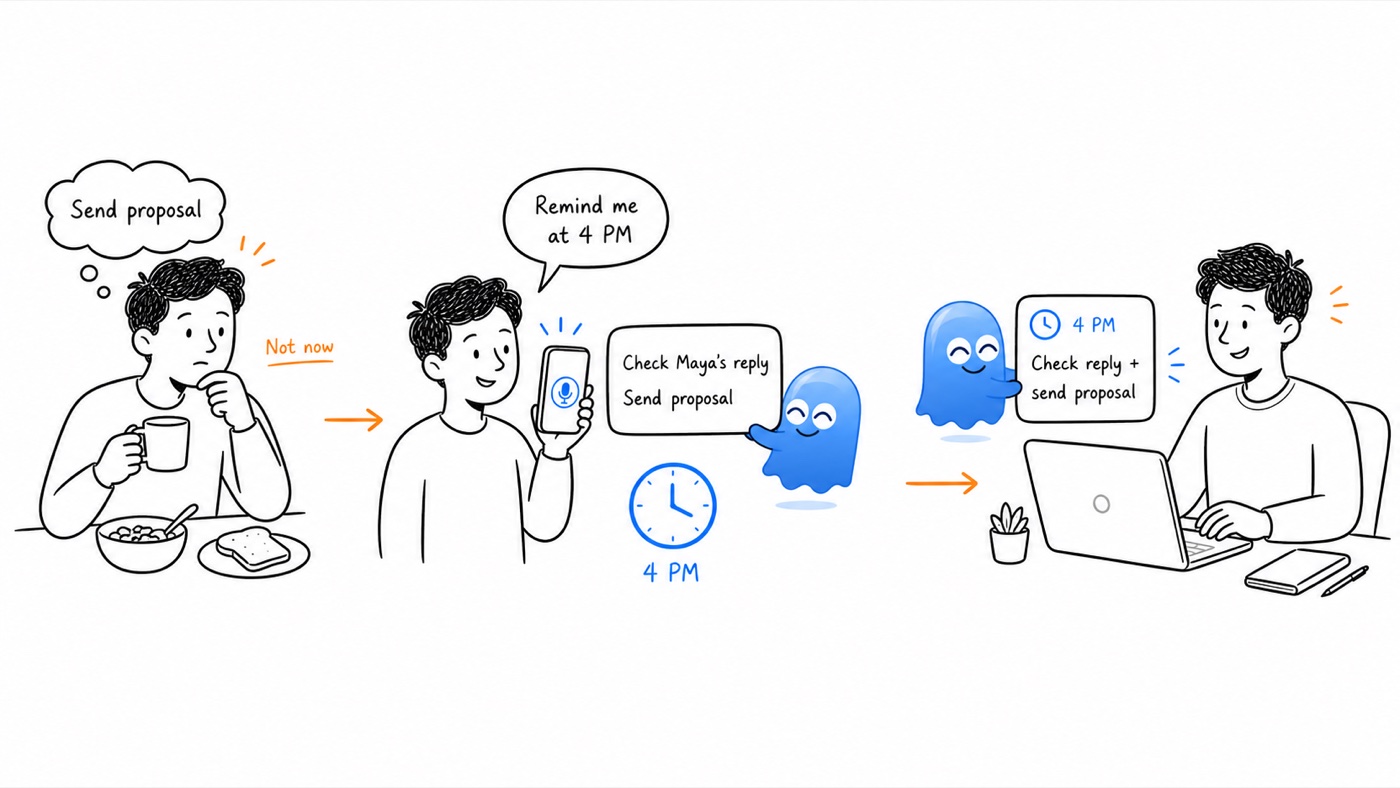
Imagine that you need to send a revised proposal after your colleague replies.
The intention exists. You understand the task. You may even feel worried about forgetting it.
But the action depends on several things happening:
- You notice the colleague's reply.
- The proposal returns to mind.
- You stop or finish what you are doing.
- You find the document.
- You make the revision.
- You send it.
“Send the proposal” looks like one task. In practice, it contains a future cue, a transition, and several actions.
Research defines prospective memory as remembering to carry out a delayed intention. A systematic review found that demanding ongoing activities can make prospective remembering harder because attention and executive resources are already occupied. This was not an ADHD-specific review, but it helps explain why a task can vanish while someone is answering messages, travelling, solving a problem, or switching between responsibilities. Read the systematic review
ADHD is not one simple memory problem
Adults with ADHD do not all experience memory in the same way.
A systematic review found group-level differences across several cognitive domains, including attention and working memory, while also showing substantial variation. ADHD cannot be reduced to “bad memory.” Read the systematic review
A 2026 study of adults with a previous community ADHD diagnosis found lower everyday prospective-memory performance in its ADHD group. The study also found preliminary benefits from imagining a future intention more concretely, but the authors noted limitations and the need for more research. Read the study
The useful takeaway is modest:
An intention is easier to act on when it is connected to a specific future situation.
“I need to send the proposal” is an intention.
“At 4 pm, check whether Maya has replied, open the proposal, update the final section, and send it” gives the intention a place to return.
Make the reminder match the real moment
A reminder is most useful when it appears while the task can actually be started.
Compare these:
- “Renew insurance.”
- “Tuesday at 12:30 pm, call the insurer while I am on lunch.”
Or:
- “Check milk.”
- “Every Friday at 8:30 am, check the milk while making breakfast before leaving for the office, so I can pick it up on my way home if needed.”
The second version carries more context. It removes some of the work of reconstructing what you meant.
Research on implementation intentions has tested a similar “if this happens, then I will do that” structure. A meta-analysis found benefits for prospective-memory performance across the studies it included, although most of that evidence should not be treated as proof of a specific effect for every adult with ADHD. Read the meta-analysis
Let the MyOffload app hold the handoff
This is where the MyOffload app is useful.
You do not have to stop and translate the thought into perfect task-manager language. Tap the mic and say the real version:
At 4 pm, remind me to check Maya's reply, update the proposal's final section, and send it.
MyOffload keeps the context and turns the useful parts into a task, date, and requested reminder for you to review.
If “update the proposal” still feels too large, tap the Break Down button. The app can turn it into smaller starting steps. When the task belongs in today's plan, tap the Plan My Day button so MyOffload can prioritize and order it with the rest of your day.
The goal is not to outsource responsibility. It is to stop asking memory alone to carry the intention, the timing, the context, and the starting steps.
A small system for tasks that keep disappearing
Use this sequence when you notice yourself saying, “I keep remembering this, but I never do it.”
1. Capture it while it is present
Do not assume the thought will return at a more convenient time.
Say it into MyOffload, put it into your existing reminder system, or write it somewhere you reliably review.
2. Name the trigger
Ask:
- When can this be done?
- What event should bring it back?
- What information or tool will I need?
3. Make the first action visible
“Sort finances” is difficult to start.
“Download the last three bank statements” is visible.
4. Review important details
An external system only helps when the time, owner, and action are correct. Review anything that could affect another person, a deadline, money, travel, or health.
5. Use completion as information
If the reminder appears but the task still repeatedly fails, the problem may not be memory. The task may be too large, badly timed, unclear, emotionally difficult, or dependent on something else.
Change the system instead of adding ten identical alerts.
If repeated reminders are affecting your relationship, read I Love My ADHD Partner, but I Am Exhausted From Reminding Them for a clearer relationship handoff.
Reminders help, but they are not a treatment
Research on cognitive offloading shows that external reminders can improve performance on the intentions they support. It also shows possible tradeoffs when reminders are later removed, so “put everything outside your brain” is too simplistic. Read the 2026 study
MyOffload has not been clinically tested as an ADHD treatment. It cannot diagnose ADHD, improve every kind of memory, or guarantee task completion.
If forgetting is new, worsening, affecting safety, or interfering substantially with daily life, talk with a qualified healthcare professional. ADHD is one possible explanation among many.
Frequently asked questions
Why do I remember a task at random times but not when I need to do it?
The thought may be returning without a useful cue. Prospective memory depends on retrieving an intention in the future, often while other activity is competing for attention.
Does forgetting a task mean I did not care enough?
No. Caring can make a task emotionally important, but importance does not automatically create a reliable retrieval cue or a clear starting action.
Should I set more alarms?
Not automatically. One well-timed reminder with enough context is usually more useful than repeated vague alerts. If reminders are repeatedly dismissed, look at timing, task size, clarity, and emotional friction.
How can MyOffload help?
The MyOffload app lets you say the whole intention naturally, then turns useful parts into tasks, dates, and requested reminders for review. Break Down can clarify the first steps, and Plan My Day can place the task into a workable order.
The bottom line
You can genuinely remember that a task matters and still fail to retrieve it at the moment of action.
That is not proof that you are lazy or careless.
Give the intention a clear cue. Preserve the context. Make the first action visible. Then let a trusted external system bring it back when you can actually do something about it.
Research behind this article
- Matos, P., Pereira, D. R., Albuquerque, P. B., & Santos, F. H. (2020). How Does Performing Demanding Activities Influence Prospective Memory? A Systematic Review. Advances in Cognitive Psychology.
- Onandia-Hinchado, I., Pardo-Palenzuela, N., & Diaz-Orueta, U. (2021). Cognitive characterization of adult attention deficit hyperactivity disorder by domains: a systematic review. Journal of Neural Transmission.
- Altgassen, M., Heinrich, H., & Edel, M. A. (2026). Episodic Future Thinking Improves Everyday Prospective Memory Performance in Adults With a Previous Diagnosis of Attention Deficit Hyperactivity Disorder by Community Providers. Journal of Attention Disorders.
- Chen, X. J., et al. (2015). The effect of implementation intention on prospective memory: a systematic and meta-analytic review. Psychiatry Research.
- Fellers, C., & Storm, B. C. (2026). Offloading reduces prospective memory learning. Journal of Experimental Psychology: Learning, Memory, and Cognition.
Try MyOffload
Give the thought somewhere useful to go
Say the messy version. MyOffload keeps the context and turns the actionable parts into tasks, notes, and requested reminders for you to review.
Download MyOffload for iPhone