
This is my experience as the non-ADHD partner in my relationship. It is one relationship, not a description of every person with ADHD or every couple.
I love my partner, whom I will call Ari here. Ari is organised, capable, and sometimes astonishingly productive. When they are focused, they can do more in a few hours than many people do in a day.
There are also times when an intention disappears between being mentioned and needing to happen.
For a long time, I tried to close that gap myself.
I remembered the task. I remembered when it needed to happen. I reminded Ari. If it still did not happen, I checked again. None of the individual reminders looked especially difficult. Together, they formed a second list that lived in my head.
The short answer
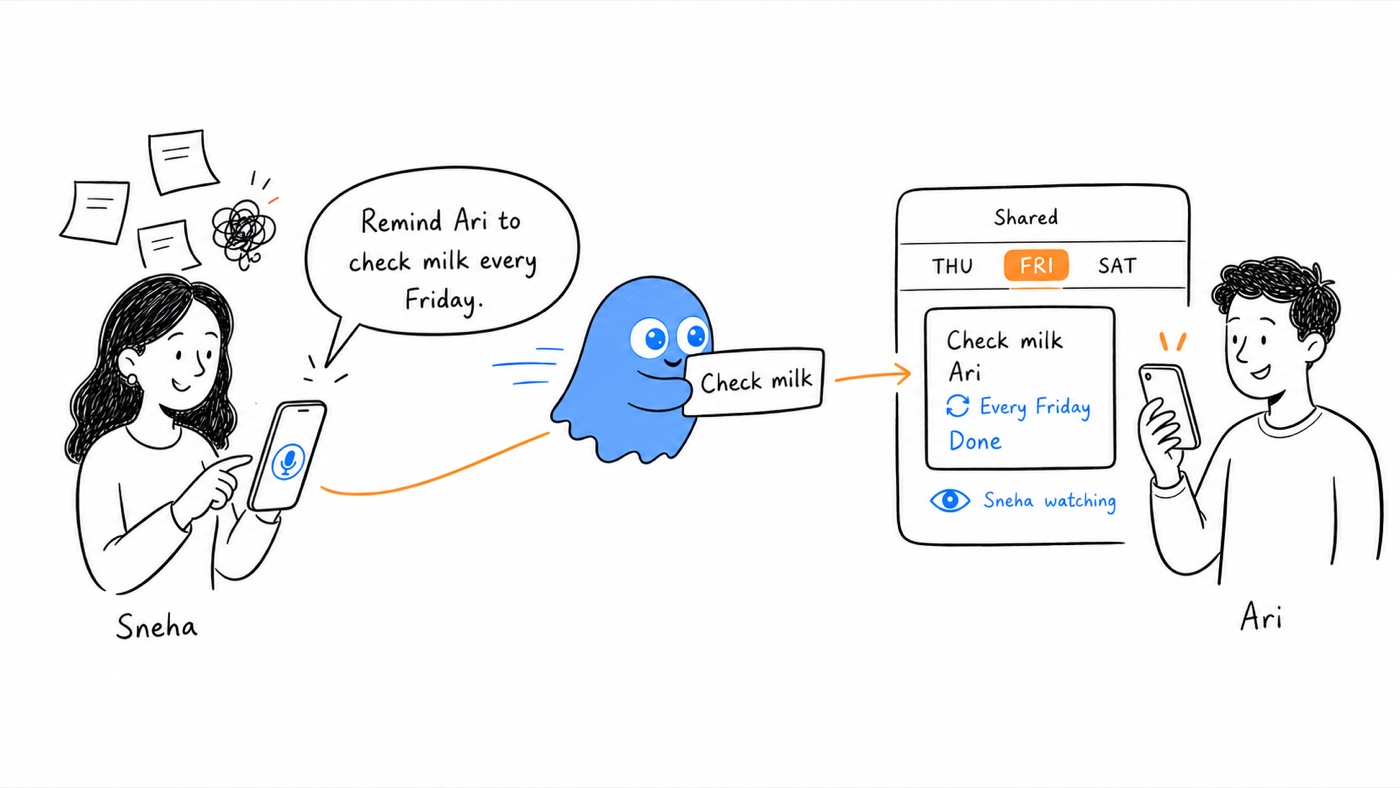
If you are exhausted from reminding a partner with ADHD, the answer is probably not to become better at reminding them.
The more sustainable goal is to create a shared external system where:
- an intention is captured when it is mentioned
- ownership is clear
- the responsible person receives the reminder
- both partners can see the agreed plan
- one partner does not have to keep carrying the task in their head
This does not remove personal responsibility. It gives responsibility somewhere clearer to live.
The small things were not really small
Here is an ordinary example from my relationship.
Ari likes tea on the weekend. Friday is the useful moment to check the milk because Ari is already at the office. If the fridge is running low, they can pick some up on the way home without making a separate trip.
Ari does not enjoy going out only to grocery shop on the weekend. If Saturday arrives without milk, they may put off that standalone trip even though they want tea. A one-minute check on Friday can prevent that friction.
When we are together, I naturally notice whether there is milk in the fridge. When we are apart, I used to carry the Friday reminder myself.
Checking for milk takes less than a minute.
Remembering the useful moment, connecting Friday's journey home to the weekend tea routine, sending the reminder, and checking whether it happened is the mental load.
The same pattern can appear around bills, household supplies, appointments, travel plans, calls, forms, and the thing someone casually says they need to do next Thursday.
A single reminder can be an act of care. Becoming the permanent reminder system is tiring.
My partner is not incapable
This distinction matters to me.
Ari having ADHD does not mean they are disorganised all the time. It does not mean they do not care. It also does not mean that every missed responsibility should be explained away by ADHD.
Adults with ADHD vary enormously. Research describes possible differences across attention, working memory, inhibition, and other cognitive domains, but it does not provide a script for one person or one relationship. A systematic review of adult ADHD cognition found group-level differences across several domains while also showing that ADHD cannot be reduced to one simple memory problem. Read the systematic review
One particularly relevant idea is prospective memory, which means remembering to execute an intention in the future.
Ari may genuinely remember that something matters. The difficult part can be retrieving that intention at the moment when action is required. A recent study found lower everyday prospective-memory performance in its adult ADHD group and described support for an intention-encoding strategy as preliminary, with important limitations. Read the prospective-memory study
That is more accurate than saying, “People with ADHD cannot remember.”
It is also more useful. If the problem sometimes sits between intention and execution, we can support that transition without turning one partner into the other partner's human notification service.
What was actually exhausting me
I was doing four kinds of work:
- Capturing: noticing that something needed to happen.
- Scheduling: deciding when it should happen.
- Reminding: bringing it back at the relevant time.
- Monitoring: checking whether it had happened.
Only the visible task belonged to Ari. Much of the coordination still belonged to me.
Research on household mental labour describes similar invisible work through anticipating, planning, monitoring, and remembering. A systematic review found that this labour was disproportionately performed by women in the largely U.S. and European middle-class heterosexual samples studied. It was also associated with stress and lower relationship satisfaction, although those findings do not prove what is happening in one couple. Read the mental-labour review
A review of research on adult ADHD and romantic relationships also found elevated relationship difficulties at the group level, while emphasizing that we still need better evidence about the specific factors that create or reduce distress. Read the relationship review
In other words, the strain is real, but “ADHD ruins relationships” is neither accurate nor helpful.
Why I designed partner sharing for the MyOffload app
I did not want to stop caring about Ari.
I wanted caring to stop requiring me to remember everything twice.
That is one reason I designed partner sharing for the MyOffload app.
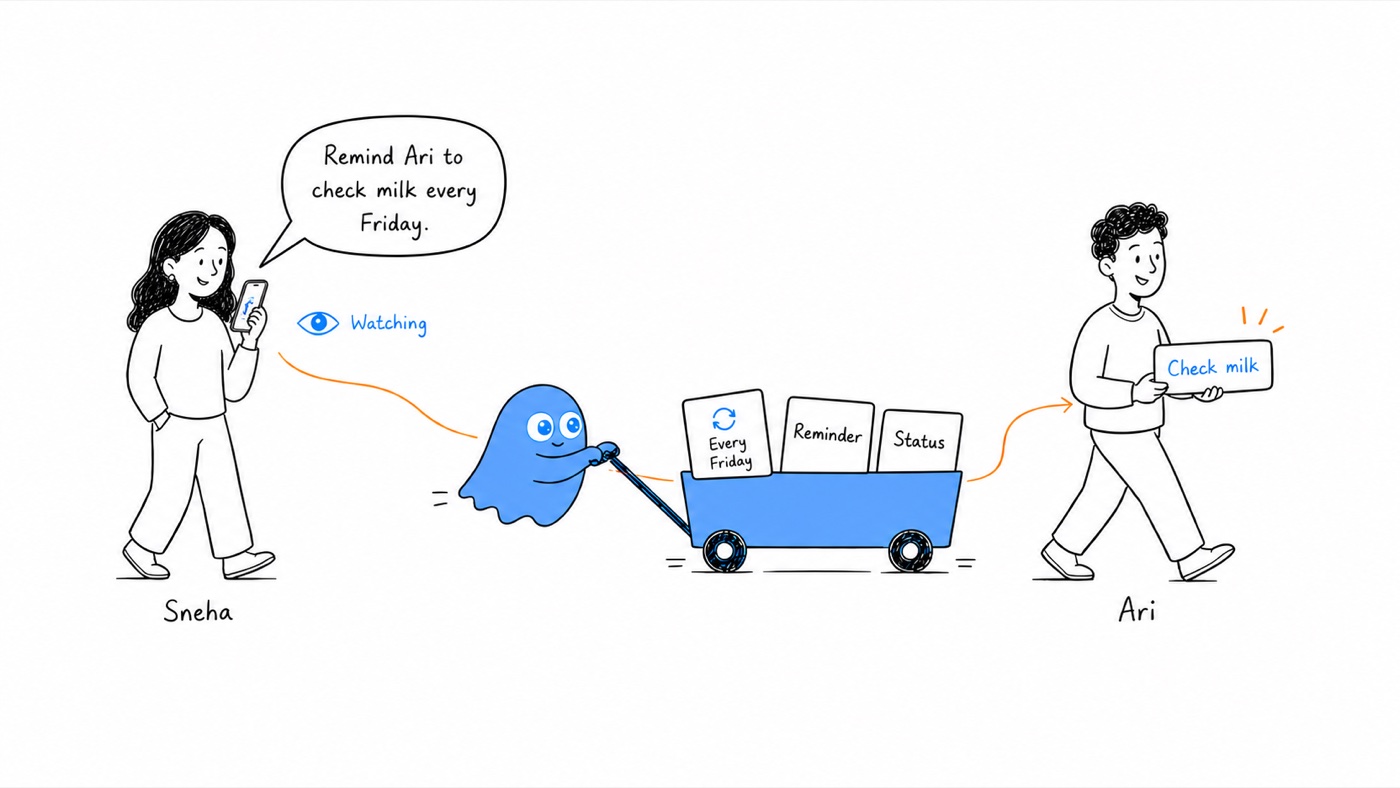
With both partners' approval, the workflow is simple. I open the app, tap the mic, and say what I need naturally:
Remind Ari to check whether there is milk every Friday evening.
The app turns that sentence into a recurring task for Ari and keeps Friday evening as the reminder time. Because I added the task to Ari's Offload, I automatically become a watcher. I do not need to ask the app to make me one.
The task also appears on our Shared screen. Dates sit across the top. We can tap a date to see that day's timeline and the tasks added to it. If Ari marks the task complete, I can see that it is done. If it is still pending, it remains visible. For a task I added to Ari, both of us receive the relevant reminders.
The direction works the other way too. If I own a task and want Ari to be able to follow it, I can say:
Remind me on Tuesday to renew the travel insurance. Add Ari as a watcher.
The task remains mine. Ari can see its status because I explicitly added them as a watcher.
The point is not to create another complicated household dashboard. It is to let one natural sentence become an owned task, a date, the right reminders, and shared visibility.
Inside the MyOffload app: Partner sharing includes automatic watcher access for the person assigning a task, shared reminders, visible task status, and the Shared screen.
Visibility should not become surveillance
A shared system only helps if both people agree on how it will be used.
Being a watcher should not mean silently supervising every action. It should mean that a genuinely shared responsibility is visible without repeated status conversations.
Before using a shared task system, couples should agree on questions such as:
- Which responsibilities should be shared?
- When is a reminder helpful?
- When is a nudge appropriate?
- Who owns the follow-through?
- Which personal tasks should remain private?
- What does “done” mean?
The app can carry an agreed plan. It cannot decide whether that plan is fair.
It also cannot create accountability where someone repeatedly refuses responsibility. ADHD may explain why a support is helpful. It does not make one partner responsible for managing the other person's life indefinitely.
What I use in the MyOffload app today
The relationship workflow grew from something I was already doing for myself in the MyOffload app.
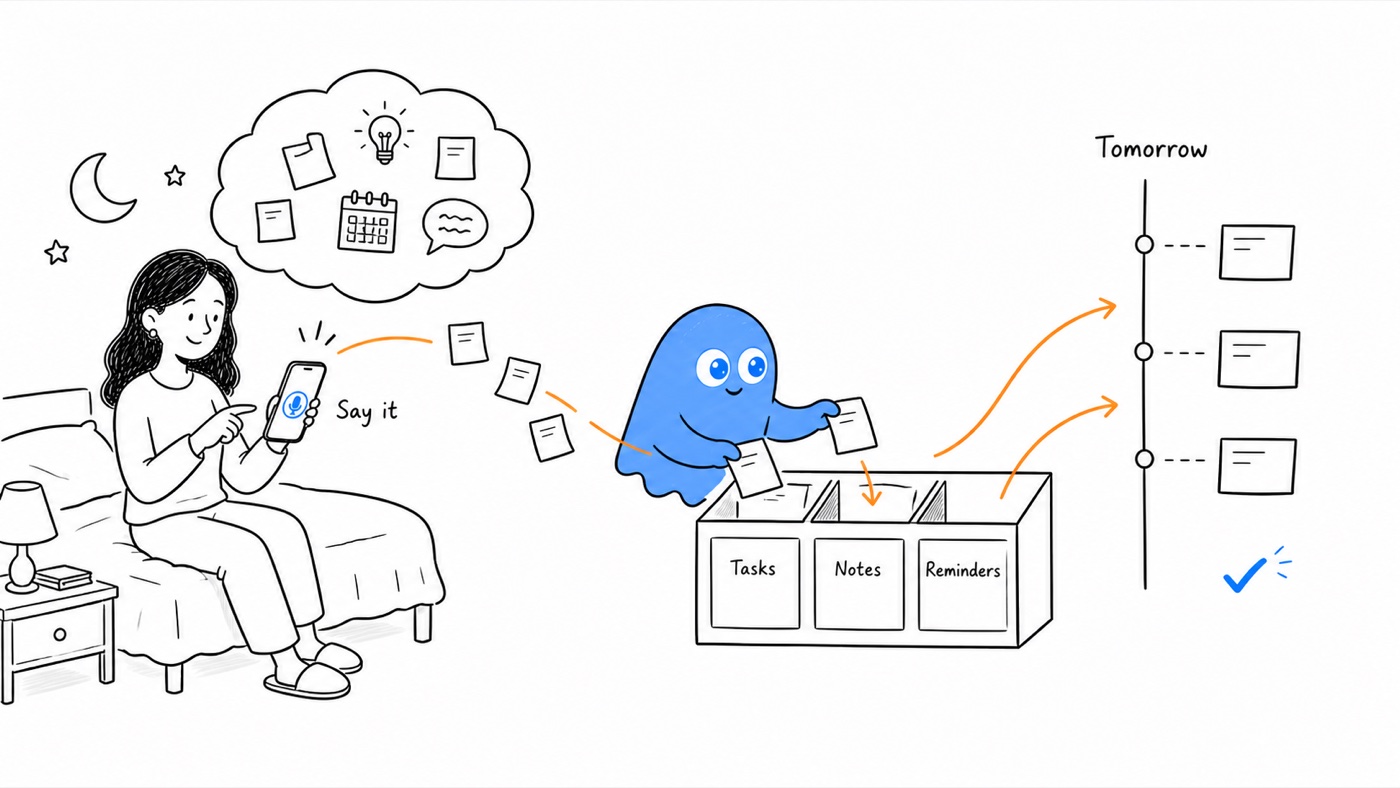
At the end of the day, I speak the unfinished contents of my mind into MyOffload. I do not prepare a perfect list. I say the tasks, reminders, notes, ideas, and future details in the order they arrive.
For example:
Tomorrow I need to review the article draft. Remind me to call the clinic after lunch. Save that we loved the mushroom dish at the restaurant but should skip the dessert next time. I need to think about the partnership proposal, but not tomorrow.
The MyOffload app keeps the context and sorts useful parts into tasks, notes, dates, and requested reminders for me to review.
My tasks no longer have to compete with relationship reminders and small pieces of information in the same mental queue. Notes such as what we enjoyed at a restaurant remain searchable the next time we make a plan. If a task feels too large, I tap the Break Down button and the MyOffload app turns it into clearer starting steps. When I am ready for tomorrow, I tap the Plan My Day button and the app prioritises and orders the tasks I have chosen. I do not have to break down every task or build the day's sequence myself.
It is a simple evening ritual: say what is still in my head, review anything important, and let tomorrow begin with a plan instead of a memory test.
If you want to try the same system manually
You can use partner sharing in the MyOffload app, or begin with this manual version if your partner is not ready to use a shared app yet.
Try this with your partner:
1. Choose one repeated source of reminders
Start with groceries, bills, appointments, household supplies, or another contained area. Do not try to rebuild the entire relationship system in one evening.
2. Name the whole responsibility
“Buy milk” is one action.
“Keep the house supplied with milk for the weekend” includes noticing, checking, buying, and following through.
Decide which responsibility you are actually transferring.
3. Capture the intention immediately
The person who owns the task should place it in their own trusted system while the conversation is happening.
In the MyOffload app, say the messy version naturally and assign it to the person who owns it. For the manual option, each partner should capture and retain their own tasks in a trusted system.
4. Agree on reminders
Ask what kind of reminder works and when it becomes unhelpful. A reminder requested in advance feels very different from an unexpected correction.
5. Review the system, not every task
After a week or two, discuss whether responsibility actually moved. If one person still has to notice, assign, and monitor everything, the task moved but the mental load did not.
What MyOffload cannot solve
No app can guarantee that a task will be completed.
MyOffload cannot treat ADHD, replace professional support, or repair a relationship where communication is unsafe. There is currently no peer-reviewed study showing that MyOffload improves ADHD symptoms or relationship outcomes.
What it can do is narrower and practical:
- capture an intention while it is available
- preserve the details
- create tasks, notes, dates, and requested reminders for review
- help make ownership visible
- reduce manual rewriting
- give each person a clearer place to find what they agreed to do
For me, that narrower change is meaningful. My brain no longer has to be the only place where our unfinished responsibilities wait.
Frequently asked questions
Is it wrong to remind a partner with ADHD?
No. Partners remind and support each other in healthy relationships. The problem is not one reminder. The problem is a pattern where one person must continually notice, schedule, remind, and monitor the other person's responsibilities.
Does ADHD excuse missed responsibilities?
ADHD can help explain why certain tasks, transitions, or delayed intentions are difficult. It does not remove the need for ownership, communication, or repair when something affects another person.
What if my ADHD partner does not want a shared system?
Do not add them to a tracking or reminder system without consent. Discuss the problem you are trying to solve, what information would be shared, and what boundaries each person needs. A tool cannot replace that agreement.
How does partner sharing work in the MyOffload app?
Tap the mic and naturally assign a dated or recurring task to your partner. The person adding the task automatically becomes a watcher. The task, timeline position, reminders, and completion status appear on the Shared screen for the people involved. The MyOffload app also helps each person capture and organise their own tasks, notes, dates, and requested reminders.
The bottom line
I love my partner. I do not want ADHD to become a blame word in our relationship, and I do not want love to mean carrying an invisible second workload forever.
The better question is not, “How can I remember more for them?”
It is, “How can we make intentions visible, assign ownership clearly, and let the responsible person receive the reminder?”
That is the relationship I designed partner sharing in the MyOffload app to support. Not one person managing two lives, but two people using a shared system to care for what they have agreed to carry.
Research behind this article
- Wymbs, B. T., Canu, W. H., Sacchetti, G. M., & Ranson, L. M. (2021). Adult ADHD and romantic relationships: What we know and what we can do to help. Journal of Marital and Family Therapy.
- Diaz-Orueta, U., et al. (2021). Cognitive characterization of adult attention deficit hyperactivity disorder by domains: a systematic review. Journal of Neural Transmission.
- Altgassen, M., Heinrich, H., & Edel, M. A. (2026). Episodic Future Thinking Improves Everyday Prospective Memory Performance in Adults With a Previous Diagnosis of Attention Deficit Hyperactivity Disorder by Community Providers. Journal of Attention Disorders.
- Reich-Stiebert, N., Froehlich, L., & Voltmer, J.-B. (2023). Gendered mental labor: A systematic literature review on the cognitive dimension of unpaid work within the household and childcare. Sex Roles.
Try MyOffload
Give the thought somewhere useful to go
Say the messy version. MyOffload keeps the context and turns the actionable parts into tasks, notes, and requested reminders for you to review.
Download MyOffload for iPhone