

“My partner helps when I ask, but I am still the person who has to know what needs asking.”
That sentence captures the difference between completing a chore and carrying its mental load.
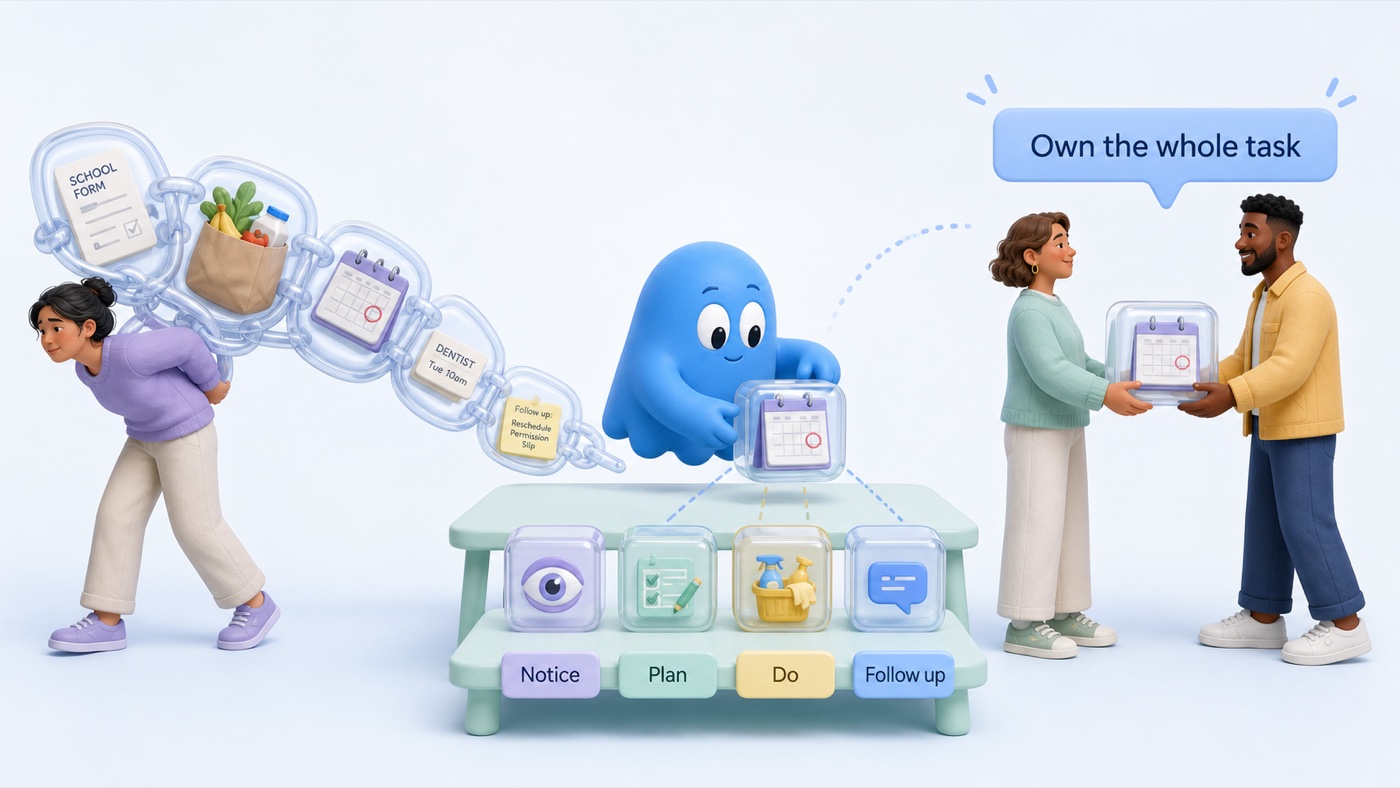
What counts as mental load?
Research uses terms such as mental labour, cognitive household labour, and invisible family load. The work can include:
- noticing that something will be needed
- anticipating a deadline or problem
- researching options
- deciding what should happen
- assigning or requesting the task
- remembering the details
- monitoring whether it happened
- handling the emotional consequences when it does not
The physical task may take ten minutes. The responsibility can remain active for days.
What the evidence shows
A systematic review of 31 peer-reviewed studies found that women performed a larger share of mental labour, particularly around childcare and parenting decisions, in the mostly U.S. and European middle-class samples studied. The review also found associations with stress, lower life and relationship satisfaction, and career effects.
A study of 322 mothers of young children found cognitive household labour was especially gendered and was associated with stress, burnout, mental health, and relationship functioning. These findings are important but do not describe every household or establish causation for one couple.
Mental load also exists in same-gender relationships, multigenerational homes, friendships, and work teams. The central issue is responsibility, not a single family structure.
Make the invisible work concrete
Choose one domain, such as school, meals, healthcare, finances, or household maintenance. Write the full chain:
- Notice
- Plan
- Decide
- Do
- Follow up
Example: “book the dentist” may include remembering when check-ups are due, finding the clinic, checking insurance, comparing calendars, booking, adding the appointment, preparing the child, arranging transport, and handling the follow-up.
Seeing the chain makes discussion more precise than “you never help” or “just tell me what to do.”
Share ownership, not isolated tasks
Helping with execution still leaves one person managing the system. A stronger handoff gives one person ownership of the whole domain, with agreed boundaries and access to the information required.
Ownership means noticing and following through, not waiting to be assigned each step.
Start with one domain rather than renegotiating the entire household at once. Decide what “done” means, what decisions require consultation, and when you will review the arrangement.
Coming soon: turn the plan into shared ownership with MyOffload
MyOffload's upcoming partner sharing feature is designed to make the whole plan visible and move each part to the person who owns it.
After you and your partner agree on the plan, you will be able to say it naturally:
I will book the dentist and take Maya to the appointment. Arjun will complete the school form by Thursday and call the insurance company tomorrow at 10.
MyOffload will separate that plan into individual tasks and keep the dates and reminder times. Either partner will be able to pass a task to the other. Each task will appear in the correct person's account, and that person will receive the reminder notification. You will not have to rewrite the conversation into two lists or keep reminding each other by hand.
For a responsibility with many steps, Break Down can make the work clearer before the handoff. For the tasks you personally own today, Plan My Day can prioritize and order them in one tap.
The important part is not simply assigning a chore. The handoff should include ownership of the follow-through. If Arjun owns the school form, that means finding the required information, completing it, submitting it, and handling the follow-up.
Partner sharing can carry the agreed plan into both accounts when the feature launches. It cannot decide whether the plan is fair. That decision still belongs to the people involved.
Keep the conversation non-blaming and specific
Try:
I am carrying the planning and follow-up for school. Can we list the complete responsibility and decide who owns it for the next month?
Avoid debating who is “naturally better” at remembering. Skills can grow when responsibility, access, and expectations are clear.
If conversations become unsafe, coercive, or controlling, productivity advice is not the right intervention. Seek appropriate professional or local support.
The bottom line
Mental load is the invisible work that keeps visible tasks moving. Name the full chain, discuss ownership rather than occasional help, test one domain, and review whether responsibility actually shifted.
Making the load visible is the beginning. Shared ownership means each person receives the work they agreed to own and carries it through to completion. MyOffload's upcoming partner sharing feature is designed to put the agreed tasks, dates, and reminders into the right accounts. The people involved still decide what fair ownership looks like.
Research behind this article
- Reich-Stiebert, N., Froehlich, L., & Voltmer, J.-B. (2023). Gendered mental labor: A systematic literature review on the cognitive dimension of unpaid work within the household and childcare. Sex Roles.
- Aviv, E., et al. (2025). Cognitive household labor: gender disparities and consequences for maternal mental health and wellbeing. Archives of Women's Mental Health.
- Ciciolla, L., & Luthar, S. S. (2019). Invisible household labor and ramifications for adjustment: Mothers as captains of households. Sex Roles.
- Pepping, C. A., et al. (2023). The management of cognitive labour in same-gender couples. PLOS ONE.
Try MyOffload
Give the thought somewhere useful to go
Say the messy version. MyOffload keeps the context and turns the actionable parts into tasks, notes, and requested reminders for you to review.
Download MyOffload for iPhone