

One partner says, “I am only reminding you because it matters.”
The other hears, “You do not trust me to manage my own life.”
Then the reminder becomes an argument, and the task still is not done.
The short answer
Couples can share reminders without creating a nagging dynamic when:
- the task has a clear owner
- the reminder is agreed in advance
- the timing matches a useful moment
- the owner receives it directly
- shared visibility replaces repeated status questions
- a missed task leads to repair, not endless chasing
The goal is not to find a nicer way for one partner to supervise the other. It is to move remembering into a shared system while keeping responsibility with the person who owns the task.
Why reminders become emotionally charged
The words may be simple:
Do not forget the appointment.
But the reminder can carry several hidden messages.
The person sending it may mean:
I care about you, this affects both of us, and I am scared it will be missed.
The person receiving it may hear:
You think I am irresponsible. You are checking on me again.
When this repeats, the couple starts reacting to the history behind the reminder rather than the sentence itself.
Research on adult ADHD and romantic relationships finds group-level relationship difficulties, but the available evidence does not support one universal explanation or one standard couple dynamic. Read the review
A qualitative study of adults with ADHD also described themes involving emotional strain and a partner-caregiver imbalance. These were participant experiences, not a description of every couple. Read the study
Separate three different things
Couples often call all of these “reminders,” but they are different.
A requested reminder
Please remind me at 6 pm to call my sister.
The person responsible has chosen the support.
A shared-task notification
The electricity payment is due tomorrow.
The system brings back an agreed responsibility that affects both people.
A live correction
You still have not called. Are you going to do it now?
This may be necessary sometimes, but emotionally it can feel more like monitoring than reminding.
Arguments grow when one partner believes they are giving the first kind while the other experiences the third.
Build the reminder when the task is agreed
The best time to discuss a reminder is usually not after the task is already late.
When the responsibility is assigned, agree on:
- Owner: Who is responsible for moving it forward?
- Trigger: When or where can it actually be done?
- Context: What will the owner need?
- Visibility: Does the other partner genuinely need status access?
- Repair: What happens if it is missed?
For example:
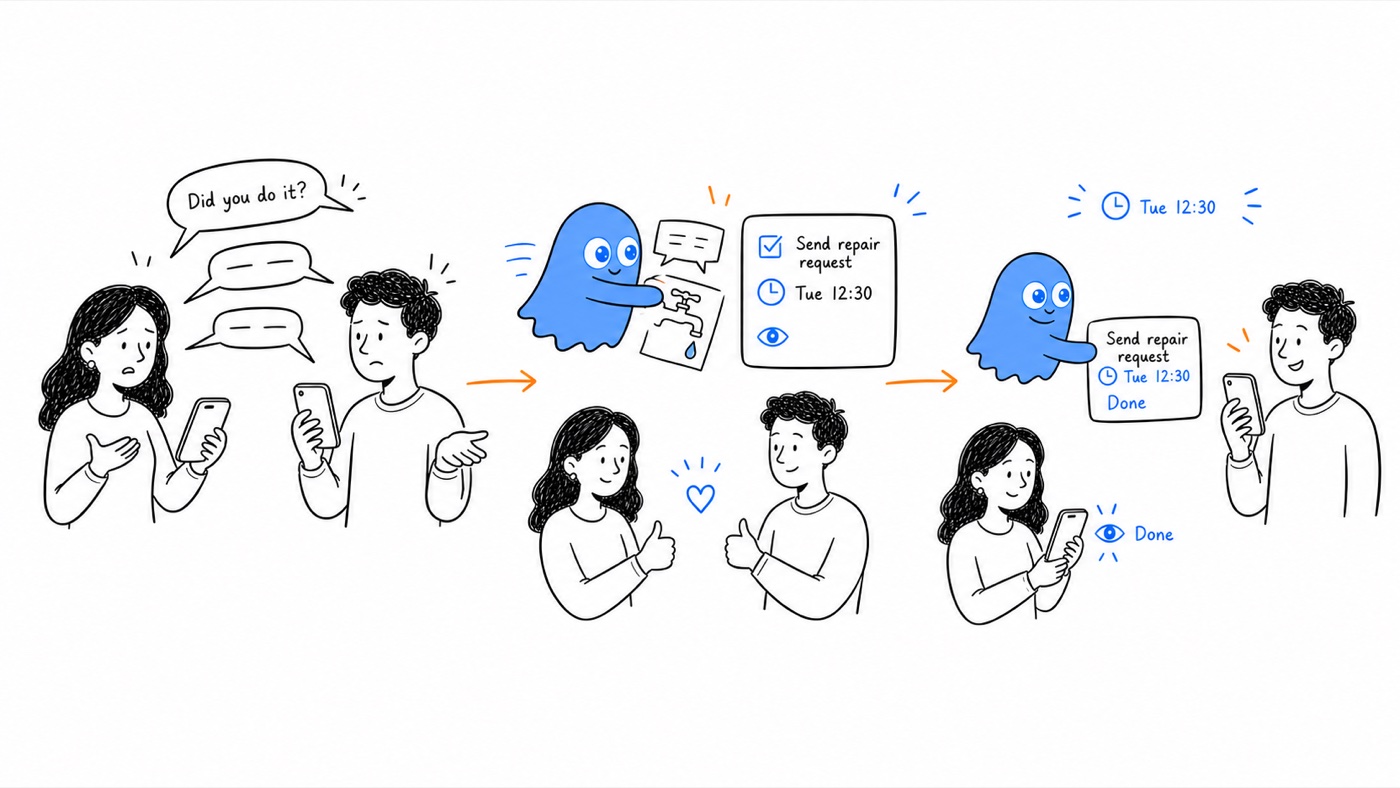
Ari owns reporting the leaking kitchen tap. On Tuesday at lunch, remind Ari to upload two photos and send the maintenance request. Sneha can watch the task because both partners need to know when the repair visit is booked.
That is clearer than Sneha remembering to ask every evening.
Say it naturally in the MyOffload app
With both partners' approval, one sentence can carry the agreement into the MyOffload app:
Remind Ari on Tuesday at 12:30 pm to upload two photos and send the kitchen tap repair request. The building maintenance number is in the apartment notes.
MyOffload turns the useful details into an owned task, date, context, and requested reminder for review. Because Sneha assigned the task to Ari, she automatically becomes a watcher.
The task appears on the Shared screen. Both partners can see the agreed date and status. When Ari marks it done, Sneha can see that without sending another message.
If Ari creates a personal task and wants Sneha to follow it, Ari can say:
Remind me to submit the visa form Thursday evening. Add Sneha as a watcher.
The task remains Ari's. Watching does not transfer ownership.
One useful reminder is better than five vague ones
Research on cognitive offloading shows that external reminders can improve performance on delayed intentions in laboratory tasks. It also shows that people do not always choose reminders optimally, and reminders can have tradeoffs. Read the cognitive offloading study
That means “more notifications” is not a scientific solution.
A useful reminder should answer:
- Why now?
- What exactly should I do?
- Can I begin from where I am?
- What information do I need?
“Kitchen repair” at 8 am during a commute is weak.
“Upload two photos and send the repair request at lunch. The maintenance number is in the apartment notes” is actionable.
Agree on a reminder boundary
Try this short conversation:
When we share a task, what kind of reminder helps you?
When does a reminder start to feel like supervision?
If the app reminder is missed, do you want one human nudge, or should you reschedule it yourself?
Which tasks need shared visibility, and which should remain private?
The answers may differ by task. A travel booking that affects both partners may need visibility. A personal reading goal probably does not.
What to do when the reminder does not work
If the same task is repeatedly missed, do not automatically add another alert.
Check the failure point:
- Was the time unrealistic?
- Was the task too large?
- Was the first action unclear?
- Was information missing?
- Was the person already overloaded?
- Did they never actually accept ownership?
- Is the task emotionally difficult or being avoided?
The Break Down button in MyOffload can help when the task hides several starting steps. The Plan My Day button can help the owner place it into a realistic order. Neither button can replace honest agreement or willingness to act.
Do not turn watching into surveillance
Shared status should reduce coordination, not create constant inspection.
Good watcher behaviour looks like:
- checking only when the shared outcome genuinely matters
- trusting the agreed reminder first
- discussing patterns at a planned time
- respecting personal tasks and boundaries
Unhelpful watcher behaviour looks like:
- checking every change
- using status as evidence in unrelated arguments
- adding tasks without consent
- treating “pending” as a character judgement
MyOffload can show the plan. The couple still decides how to treat each other around it.
If one partner is still creating and monitoring every reminder, the deeper issue may be ownership rather than notification style. Read What Task Ownership Actually Means in a Relationship.
Frequently asked questions
Is it nagging if my partner asked me to remind them?
Not automatically. A requested reminder is agreed support. It can still become unhelpful if the timing, frequency, or tone changes beyond what was agreed.
Should both partners receive every reminder?
No. The task owner should receive the action reminder. The other partner only needs shared visibility or notifications when the outcome genuinely affects them and both people agree.
What if my partner ignores app reminders too?
Look beyond the notification. The task may be unclear, badly timed, too large, unwanted, or emotionally difficult. Repeated failure needs a system conversation and accountability, not endless alerts.
Can MyOffload prevent arguments?
It cannot guarantee that. It can reduce manual coordination by preserving the task, owner, timing, context, and status in one place.
The bottom line
The most helpful reminder is not the one repeated most often.
It is the reminder designed with consent, attached to a useful moment, delivered to the responsible person, and supported by a clear definition of what happens next.
Let the system bring back the task. Let the owner carry the follow-through. Let the relationship contain care without making one person the permanent alarm.
Research behind this article
- Wymbs, B. T., et al. (2021). Adult ADHD and romantic relationships: What we know and what we can do to help. Journal of Marital and Family Therapy.
- O'Brien, M., et al. (2026). “I Felt Like a Burden”: An Exploration Into the Experience of Romantic Relationships for People With ADHD. Journal of Marital and Family Therapy.
- Boldt, A., & Gilbert, S. J. (2019). Confidence guides spontaneous cognitive offloading. Cognitive Research: Principles and Implications.
- Chen, X. J., et al. (2015). The effect of implementation intention on prospective memory: a systematic and meta-analytic review. Psychiatry Research.
Try MyOffload
Give the thought somewhere useful to go
Say the messy version. MyOffload keeps the context and turns the actionable parts into tasks, notes, and requested reminders for you to review.
Download MyOffload for iPhone