

You remind them to wake up.
You ask whether they sent the email.
You check the appointment time, notice the bill, replace the groceries, and follow up on the task they said they would do.
Eventually, you are not only doing more. You are managing.
That can leave one partner feeling like a parent and the other feeling watched, corrected, or incapable.
The short answer
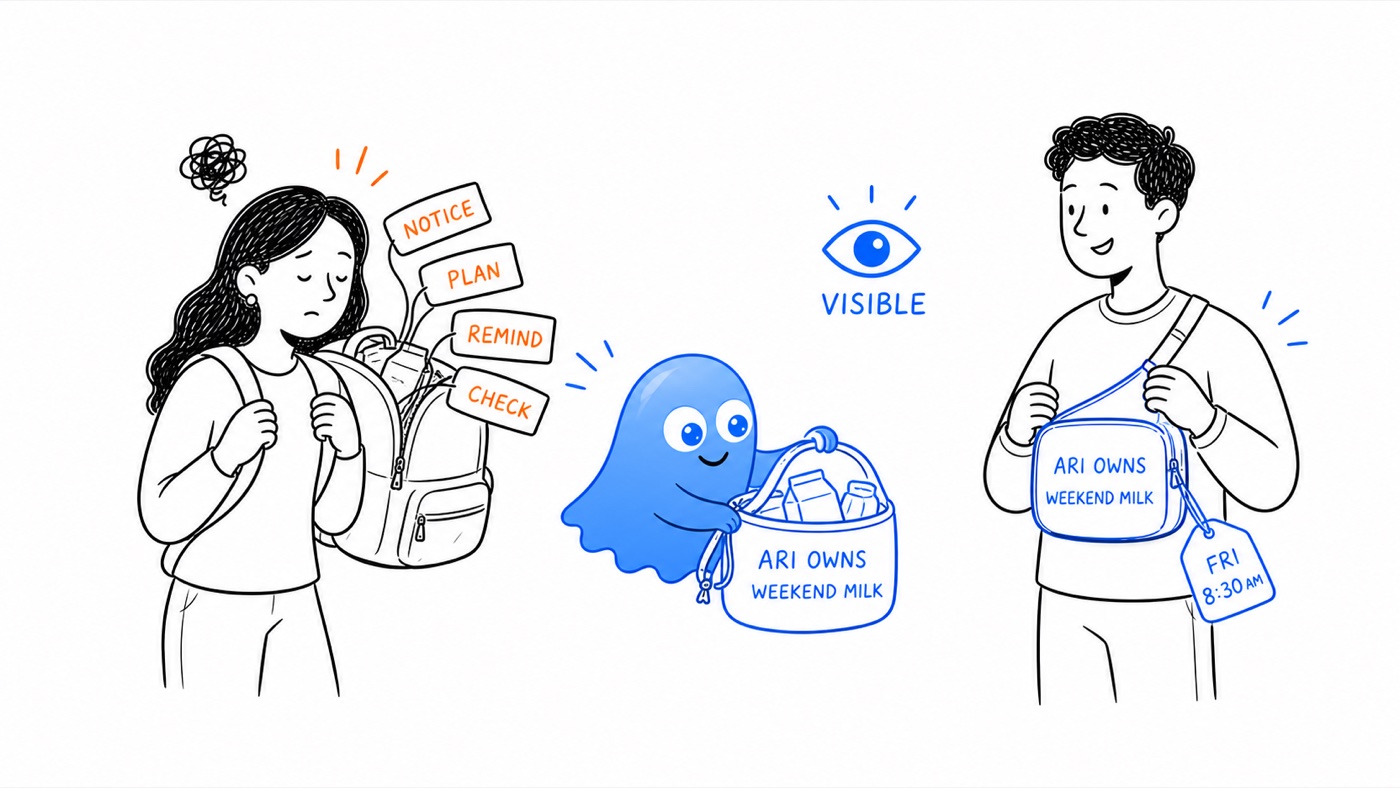
To change a parent-child dynamic, transfer the whole responsibility, not only the final action.
That means the person who owns a task also owns:
- noticing it
- planning it
- remembering it
- asking for help when needed
- completing it
- repairing the consequences if it is missed
Support can still exist. The difference is that support is agreed and requested, not silently required for the household to function.
How the dynamic develops
It often starts with care.
One partner notices that the other is overwhelmed, running late, or forgetting something important. They step in. The immediate problem is solved.
Then it happens again.
The more one person compensates, the less visible the original responsibility becomes. Soon, the couple is arguing about tone, reminders, and gratitude while the ownership problem remains untouched.
A 2026 qualitative study of adults with ADHD identified a theme described as being between partner and caregiver. Participants also described emotional strain, instability, and the importance of self-understanding. This study represents reported experiences, not a rule for every ADHD relationship. Read the study
A review of adult ADHD and romantic relationships found elevated difficulties at the group level but also noted significant gaps in the evidence. There is no single ADHD relationship pattern. Read the review
Signs that support has become management
You may be in a manager role when:
- you know your partner's deadlines better than they do
- you cannot relax after they accept a task
- you create the plan and assign every step
- they wait for your reminder before starting
- you monitor completion because the consequence will fall on you
- they experience neutral questions as supervision
- you feel guilty when you stop rescuing
- both of you discuss your partner's tasks as if they still belong to you
One or two examples do not define a relationship. Look for the repeating structure.
Stop transferring only the physical step
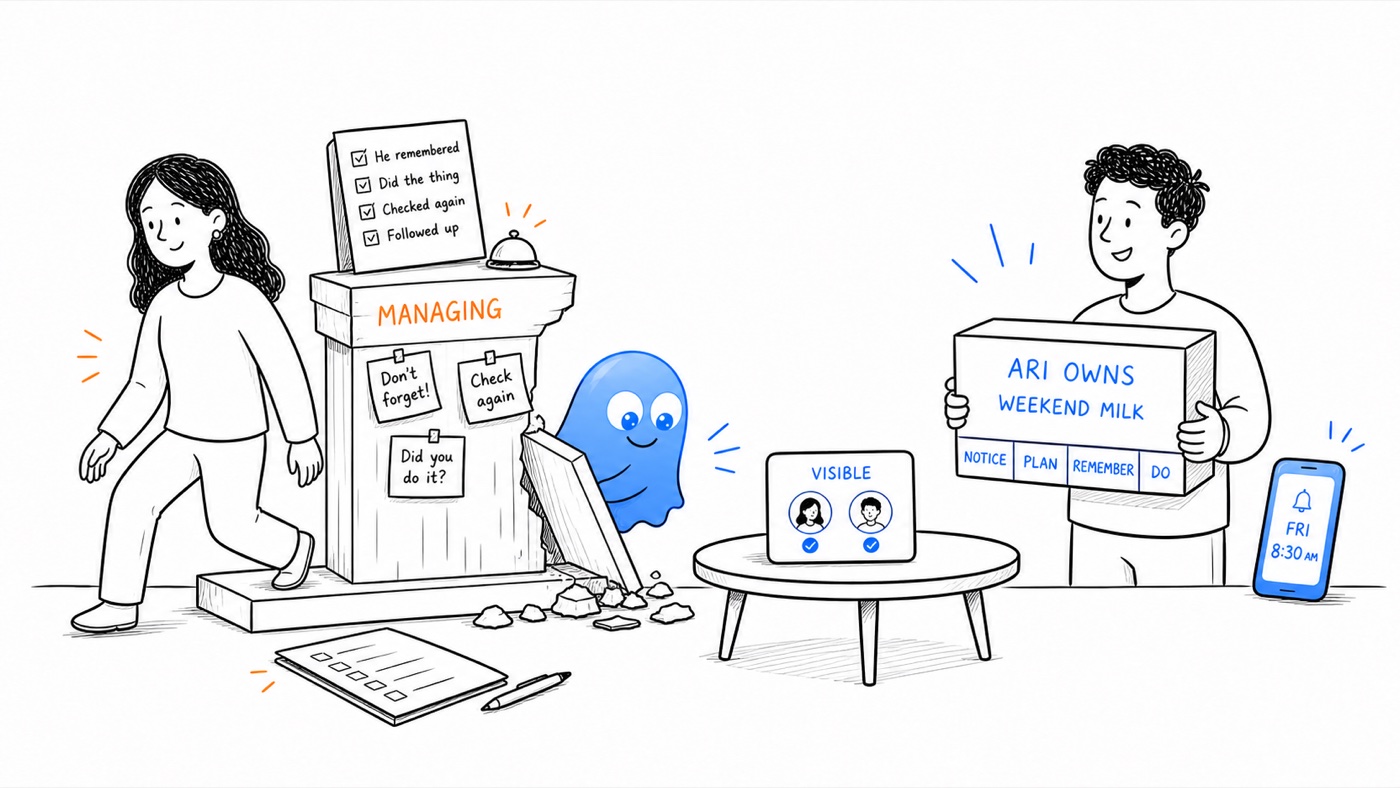
“Can you buy milk?” transfers one action.
It does not necessarily transfer:
- noticing when milk is low
- knowing when the next shop is practical
- remembering what quantity is needed
- adding it to a route
- checking that it was bought
Research on cognitive household labor describes four forms of invisible work: anticipating needs, identifying options, making decisions, and monitoring progress. In one influential qualitative study of 35 couples, women performed more cognitive labor overall, particularly anticipation and monitoring. The sample and design do not justify applying that finding to every household, but the framework is useful for seeing what “ownership” can hide. Read the study
If one partner still anticipates and monitors, the other partner may be helping without actually owning the responsibility.
Choose one responsibility to transfer fully
Do not begin by redesigning the entire relationship.
Choose one contained area, such as:
- weekend groceries
- one monthly bill
- pet medication
- booking a recurring appointment
- maintaining one household supply
- managing one part of an upcoming trip
Then agree on what full ownership includes.
For example:
Ari owns weekend milk. That includes checking it every Friday, buying it on the way home if needed, and changing the plan if Friday is unusual.
Sneha does not need to remember Friday for Ari.
Put the responsibility in the owner's system
With both partners' approval, MyOffload can make that transfer concrete.
In the MyOffload app, Ari can tap the mic and say:
Every Friday at 8:30 am, remind me to check the milk while making breakfast before leaving for the office. If we need more, remind me to pick it up on my way home.
The recurring task, context, and requested reminder stay in Ari's Offload for review.
If Sneha needs visibility because the task affects a shared plan, Ari can add her as a watcher. If Sneha assigns the task to Ari with their shared agreement, Sneha automatically becomes a watcher. Completion is visible on the Shared screen without Sneha having to ask, “Did you do it?”
Boo carries the coordination. Ari still carries the responsibility.
Use support requests, not invisible rescue
Healthy support can sound like:
- “Can you sit with me while I make the call?”
- “Can you check my plan once before I submit it?”
- “Please remind me verbally if I have not left by 9 am.”
- “This task has become larger than I expected. Can we renegotiate it?”
The person who owns the task asks for a defined kind of help.
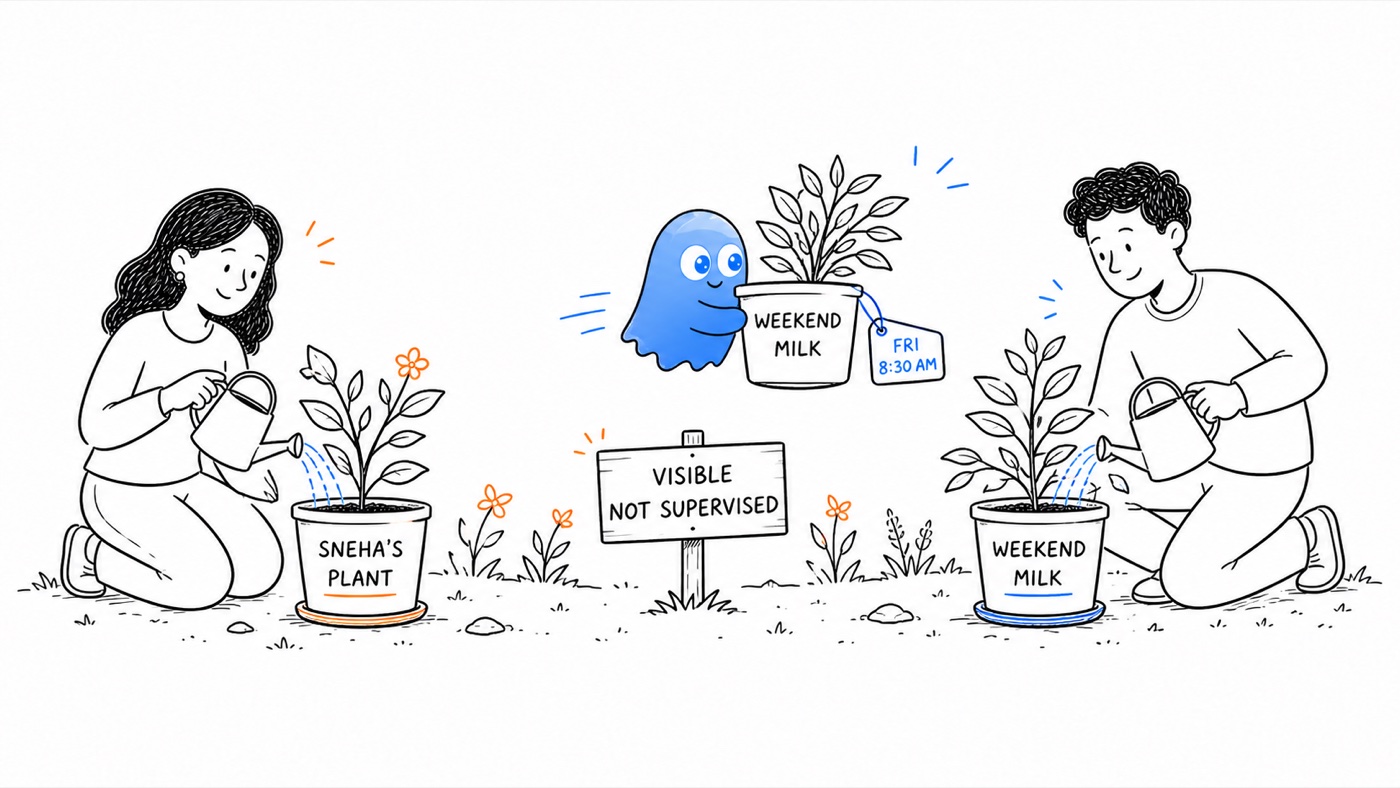
Invisible rescue sounds like one partner quietly noticing, fixing, and monitoring because failure feels too risky.
The difference is not whether partners help each other. The difference is whether responsibility remains visible.
Expect discomfort during the change
The managing partner may feel anxious when they stop checking.
The managed partner may initially miss tasks or feel abandoned when familiar prompting disappears.
That does not mean the old dynamic was healthy. It means the couple needs a deliberate transition.
Agree in advance:
- which consequences are safe to experience
- which responsibilities are too important for an experiment
- how missed tasks will be repaired
- when the system will be reviewed
- whether professional support would help
Do not test a new system with medication, child safety, legal deadlines, or another responsibility where failure could cause serious harm.
What responsibility does not mean
Responsibility does not mean doing everything alone.
It means remaining the person who drives the task forward.
You can ask for information. You can delegate a step. You can request body doubling or support. You can change the plan.
What you should not do is quietly return the entire task to your partner while still describing it as yours.
The distinction becomes clearer when the whole hidden chain is visible. Read Mental Load in Relationships: What Counts? and My ADHD Partner Promises to Do Things but Forgets.
When this is bigger than task management
An app cannot fix contempt, coercion, fear, dishonesty, or repeated refusal to take responsibility.
If conversations are unsafe, if one partner controls the other, or if the relationship is causing serious distress, consider support from a qualified individual or couples professional. If ADHD symptoms are substantially affecting daily life, assessment and treatment belong with qualified healthcare professionals.
MyOffload has not been clinically tested as an ADHD or relationship intervention.
Frequently asked questions
Is reminding my ADHD partner always parenting them?
No. Partners remind each other. The concern is a repeating structure where one person must continually notice, plan, remind, and monitor the other person's responsibilities.
What if the task fails after I stop reminding them?
The person who owns it should repair the consequence and adjust their system. Start with a responsibility where a missed attempt is manageable, not dangerous.
Is a shared task app just another way to supervise my partner?
It can become one if it is used without consent or for constant monitoring. Shared visibility should be limited to genuinely shared responsibilities and governed by clear boundaries.
How does MyOffload help without making me the manager?
The task lives with its owner, who receives the reminder and can break it down or plan it into their day. A watcher can see agreed status without carrying the task or repeatedly asking for updates.
The bottom line
You do not stop feeling like a parent by becoming more patient at managing another adult.
You change the structure.
Transfer the whole responsibility. Put it in the owner's system. Agree on limited support. Make completion visible only where it genuinely needs to be shared. Then let each adult carry the follow-through and repair that belongs to them.
Research behind this article
- O'Brien, M., et al. (2026). “I Felt Like a Burden”: An Exploration Into the Experience of Romantic Relationships for People With ADHD. Journal of Marital and Family Therapy.
- Wymbs, B. T., et al. (2021). Adult ADHD and romantic relationships: What we know and what we can do to help. Journal of Marital and Family Therapy.
- Daminger, A. (2019). The Cognitive Dimension of Household Labor. American Sociological Review.
- Reich-Stiebert, N., Froehlich, L., & Voltmer, J.-B. (2023). Gendered mental labor: A systematic literature review on the cognitive dimension of unpaid work within the household and childcare. Sex Roles.
Try MyOffload
Give the thought somewhere useful to go
Say the messy version. MyOffload keeps the context and turns the actionable parts into tasks, notes, and requested reminders for you to review.
Download MyOffload for iPhone