

Your partner says, “I will do it.”
You believe them.
Then the deadline passes, the bill remains unpaid, or the item is still sitting by the door.
When this happens repeatedly, the argument is no longer about one forgotten task. It becomes about whether words can be trusted.
The short answer
An honest intention can still fail between the promise and the moment of action.
ADHD may contribute to that gap for some people through difficulties involving attention, delayed intentions, task initiation, planning, or transitions. That can explain why a support system is useful. It does not erase the effect on the partner who was relying on the promise.
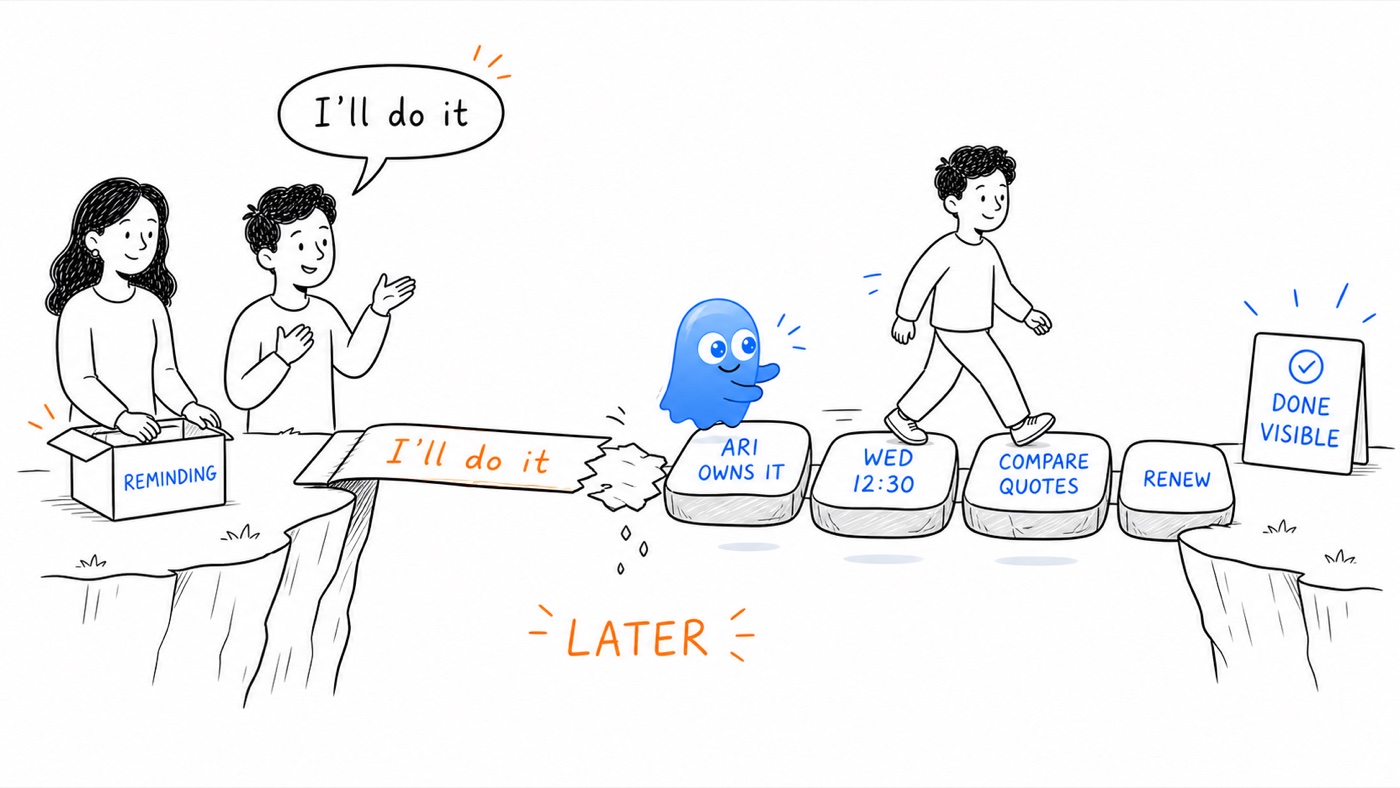
The practical goal is to turn “I will do it” into:
- a clearly owned task
- a realistic time or trigger
- enough context to start
- a reminder received by the responsible person
- visible completion when the task affects both partners
A promise is not yet a plan
Consider this conversation:
“Can you renew the car insurance this week?”
>
“Yes, I will do it.”
Both people may leave the conversation believing the responsibility is settled.
But several decisions are still missing:
- Which day?
- What information is needed?
- Is the renewal online or by phone?
- Does a quote need to be compared?
- What happens if the first attempt fails?
- How will both partners know it is complete?
The promise creates an intention. It does not automatically create the conditions for follow-through.
Why the intention can disappear
Prospective memory is the ability to remember to carry out a future intention. Research suggests that demanding ongoing activities can interfere with prospective remembering because attention and executive resources are already occupied. Read the systematic review
A recent study also found lower everyday intention execution in a group of adults with a previous community ADHD diagnosis. Its findings support further study of strategies that make future intentions more concrete, but they do not mean every broken promise in a relationship is caused by ADHD. Read the study
Other possibilities matter too. The person may have misunderstood the request, agreed too quickly, avoided a difficult conversation, underestimated the task, or failed to take responsibility.
ADHD can be part of the explanation. It should not become a universal explanation that ends the conversation.
The trust injury is real
The non-ADHD partner may hear:
“I said yes because I meant yes.”
But experience:
“I cannot relax when you say yes because I still have to remember it for both of us.”
The partner with ADHD may experience repeated failure as shame, criticism, or the feeling that nothing they do is enough.
A 2026 qualitative study involving adults with ADHD identified themes that included emotional strain and a dynamic between partner and caregiver. It reflects participant experiences rather than proving that all ADHD relationships follow this pattern. Read the study
A broader review also found elevated romantic relationship difficulties at the group level while emphasizing that the evidence base still has important gaps. Read the review
Both experiences can be true at once. One person may have meant the promise. The other person may still have been harmed by relying on it.
Capture the agreement before the conversation ends
When a shared responsibility matters, do not leave it as spoken memory.
In the MyOffload app, the person accepting the responsibility can tap the mic and say:
Renew the car insurance on Wednesday at lunch. First compare the current renewal with two other quotes. Add Sneha as a watcher.
The task stays with the person who owns it. MyOffload preserves the context, date, and requested reminder for review. Sneha can see the status because she was added as a watcher, but she does not become responsible for completing or repeatedly reconstructing the task.
If the task is assigned directly by a partner with both people's approval, the person who adds it automatically becomes a watcher. The task appears on the Shared screen, and its status is visible to the people involved.
If “renew insurance” still hides too much work, the responsible partner can tap the Break Down button. MyOffload can create clearer starting steps. The Plan My Day button can then place those steps into a realistic order with the rest of the day.
This is not proof that the task will happen. It is a clearer handoff than “I will remember.”
Replace repeated reminders with one agreed system
Try this five-part handoff:
1. Confirm the whole responsibility
Ask, “What exactly are you taking ownership of?”
Renewing insurance may include finding documents, comparing options, paying, and sharing confirmation.
2. Choose the next useful moment
“Sometime this week” is easy to lose.
“Wednesday at lunch, when I have my laptop and policy number” is clearer.
3. Capture it in the owner's system
The person who accepted the responsibility should retain it in the system they actually use.
4. Decide what visibility is needed
If the outcome affects both partners, completion can be visible without one person supervising every step.
5. Agree on what happens if it is missed
Will the owner reschedule it? Tell the other partner? Ask for help? Repair any consequence?
Accountability begins before failure, not during the argument afterward.
What not to do
Do not convert every promise into parental supervision
Checking every hour may get one task finished while making the relationship more unequal.
Do not use ADHD as a character judgement
“You never care” does not identify the failed part of the system.
Do not use ADHD as automatic absolution
“That is just my ADHD” does not repair the effect of a missed responsibility.
Do not keep accepting vague commitments for important tasks
Clarity may feel less romantic than trust, but repeated ambiguity is not trust either.
A forgotten promise still needs repair
A useful repair sounds like:
I agreed to do this, and I missed it. I know that meant you had to carry it again. I have rescheduled it for tomorrow at 10 am, added the documents I need, and set the reminder. If I cannot complete it then, I will tell you before the deadline.
The repair contains ownership, impact, and a new plan.
It does not ask the hurt partner to build the replacement system.
For the complete ownership chain, read Mental Load in Relationships: What Counts?. If reminders themselves are creating conflict, read I Love My ADHD Partner, but I Am Exhausted From Reminding Them.
What MyOffload can and cannot do
MyOffload can:
- capture an agreement while it is being discussed
- preserve ownership, timing, and context
- create tasks, dates, and requested reminders for review
- make agreed shared tasks visible
- help break down a large task
- help organize the owner's day
It cannot:
- make someone accept responsibility
- guarantee completion
- treat ADHD
- decide whether a promise was fair
- repair dishonesty, coercion, or an unsafe relationship
There is no peer-reviewed research showing that MyOffload improves relationship outcomes.
Frequently asked questions
Is my ADHD partner lying when they promise and forget?
Not necessarily. An intention can be sincere and still fail later. However, only the people involved can assess a particular pattern, and repeated promises without ownership or repair still damage trust.
Should I stop trusting my partner?
You do not need to choose between blind trust and complete distrust. For important shared responsibilities, trust can include a visible plan, clear ownership, and honest communication when something changes.
Am I supposed to put every task into the system for them?
No. If you capture a shared task, ownership should still transfer. Your partner also needs a reliable way to capture their own commitments.
Can reminders solve this completely?
No. Reminders can bring back an intention. They cannot solve unclear ownership, avoidance, resentment, unrealistic commitments, or refusal to follow through.
The bottom line
The question is not only, “Did my partner mean the promise?”
It is also, “Did that promise become an owned and workable plan?”
Turn the agreement into a task while it is still present. Give it a time, enough context, and a visible definition of done. Then let the responsible person carry the follow-through and the repair if it is missed.
Research behind this article
- Wymbs, B. T., Canu, W. H., Sacchetti, G. M., & Ranson, L. M. (2021). Adult ADHD and romantic relationships: What we know and what we can do to help. Journal of Marital and Family Therapy.
- O'Brien, M., et al. (2026). “I Felt Like a Burden”: An Exploration Into the Experience of Romantic Relationships for People With ADHD. Journal of Marital and Family Therapy.
- Matos, P., et al. (2020). How Does Performing Demanding Activities Influence Prospective Memory? A Systematic Review. Advances in Cognitive Psychology.
- Altgassen, M., Heinrich, H., & Edel, M. A. (2026). Episodic Future Thinking Improves Everyday Prospective Memory Performance in Adults With a Previous Diagnosis of ADHD by Community Providers. Journal of Attention Disorders.
Try MyOffload
Give the thought somewhere useful to go
Say the messy version. MyOffload keeps the context and turns the actionable parts into tasks, notes, and requested reminders for you to review.
Download MyOffload for iPhone