

“I did it when you asked.”
That can be true.
It can also be true that someone else noticed the need, researched the options, chose the timing, gave the instructions, reminded you, and checked the result.
You did the task.
They owned it.
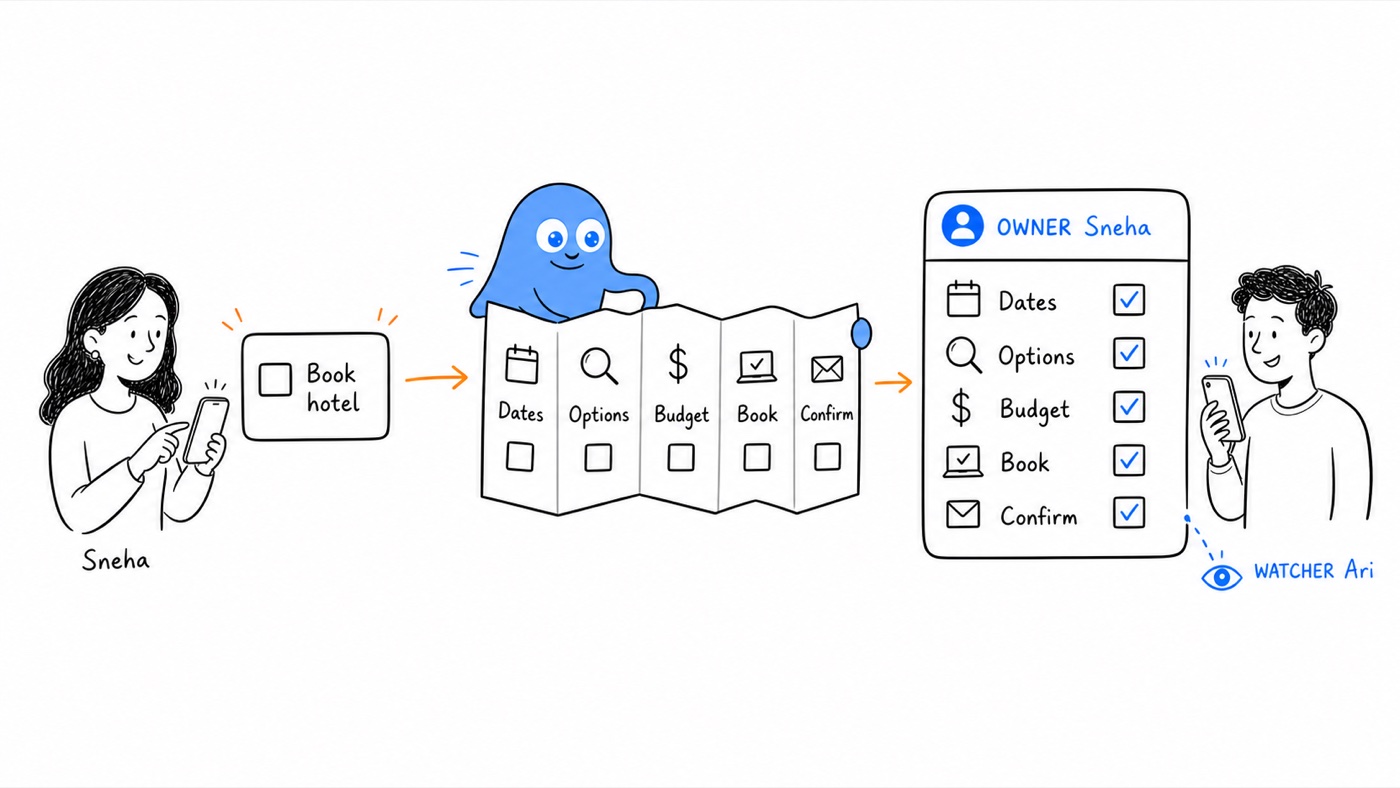
The short answer
Task ownership means being responsible for the whole path:
- Notice what needs attention.
- Clarify what “done” means.
- Decide when and how it will happen.
- Capture the plan.
- Complete or delegate the actions.
- Communicate when the plan changes.
- Confirm the result and repair misses.
Partners can help each other at any point. Help does not transfer ownership unless the couple explicitly agrees that it does.
Why couples argue about work they both believe they did
Consider a weekend trip.
One partner books the hotel after receiving a link.
The other partner:
- chooses the destination
- checks both schedules
- compares transport
- researches neighbourhoods
- selects three hotels
- confirms the budget
- sends the preferred link
- remembers the cancellation deadline
- checks that the booking arrived
If the couple counts only clicks, one person “booked the trip.”
If the couple counts ownership, the distribution looks different.
Research on cognitive household labor describes hidden work through anticipating needs, identifying options, making decisions, and monitoring progress. The framework comes from qualitative interviews with 35 couples and should not be treated as a universal measurement tool, but it makes the invisible path easier to discuss. Read the study
Ownership is not the same as doing everything yourself
An owner can:
- ask a partner for information
- delegate one step
- request support
- use reminders
- use automation
- renegotiate a deadline
- decide that the task is no longer necessary
The owner remains responsible for keeping the task moving and communicating changes.
For example, Sneha may own the visa application while Ari supplies a document. Ari owns that document step. Sneha still owns the overall application unless they explicitly transfer it.
Define “done” before the task starts
Many task conflicts are definition conflicts.
“Clean the kitchen” might mean:
- put dishes into the dishwasher
- run the dishwasher
- wipe counters
- clear the table
- take out food waste
- leave the sink empty
If one partner believes the task ends after loading dishes and the other expects the full reset, both may feel unfairly judged.
Ask:
What would we both need to see to consider this complete?
For a complex task, write the answer into the task context once. Do not rely on a resentful correction afterward.
Ownership for ADHD couples
ADHD may make certain parts of ownership more difficult for some adults, including holding future intentions, estimating time, organizing steps, initiating, or shifting attention.
That does not mean the partner with ADHD cannot own responsibilities.
It means the support should target the difficult part without quietly transferring the entire chain.
A systematic review of adult ADHD cognition found group-level differences across several domains, with meaningful variation across people and studies. Read the review
A systematic review of self-care strategies used by adults with ADHD identified external aids and supportive relationships among the themes in a small qualitative evidence base. It does not prove which specific tool works best, but it supports taking practical external strategies seriously. Read the review
Put the whole task into MyOffload
The MyOffload app is most useful when it receives the whole responsibility, not a vague label.
Instead of saying:
Visa.
Say:
Submit my visa application by Thursday. Tomorrow at lunch, remind me to upload the passport scan and bank statement. I am waiting for Ari's invitation letter. Add Ari as a watcher.
MyOffload preserves the task, deadline, context, dependency, and requested reminder for review.
If the task feels too large, tap the Break Down button. The app can turn the responsibility into clearer steps. When the steps need to fit into the day, tap the Plan My Day button to prioritize and order them.
Ari can see the shared status because they were added as a watcher. Ari does not become the owner of the application.
Use four fields for shared responsibilities
For any task that affects both partners, agree on:
Owner
Who drives the task forward?
Definition of done
What outcome closes it?
Timing
When will it happen, and what is the actual deadline?
Visibility
Who needs to see the status, and why?
That is enough for many tasks. A household should not need project-management bureaucracy for every small action.
When ownership needs to change
Life changes. Capacity changes.
An owner may need to transfer a responsibility because of illness, travel, workload, pregnancy, caregiving, or another constraint.
A clean transfer sounds like:
I own the school registration, but I cannot complete it before the deadline. Can you take full ownership? I have already collected the documents and written the remaining steps.
The new owner explicitly accepts. The context moves with the task.
Dropping a half-finished responsibility and assuming the other person will notice is not a transfer.
Accountability without blame
When an owned task is missed, ask:
- What consequence occurred?
- Who needs to be informed?
- What repair is required?
- Which part of the system failed?
- What will change next time?
The goal is not to prove that one person is unreliable forever. It is to ensure that the person affected is not left holding both the consequence and the repair.
When the repeated problem begins with sincere promises that disappear later, read My ADHD Partner Promises to Do Things but Forgets.
What MyOffload cannot decide
MyOffload can hold the task, context, timing, requested reminders, breakdown, daily order, watcher, and status.
It cannot decide:
- whether the original division was fair
- whether someone genuinely consented
- whether a partner should forgive a repeated miss
- whether a relationship is safe
- whether ADHD treatment is appropriate
There is no peer-reviewed research showing that MyOffload changes household equality or relationship outcomes.
Frequently asked questions
If I have to ask my partner to do it, do they own it?
They may own the action after accepting it, but not necessarily the whole recurring responsibility. Decide whether you are requesting one step or transferring the entire chain.
Can two people own the same task?
They can share an outcome, but it still helps to name who drives each part. “Both of us” can become “nobody noticed” when the next action is unclear.
Is being a watcher the same as being responsible?
No. A watcher can see agreed status. The owner remains responsible for moving the task forward.
What if my partner needs help breaking down every task?
Use tools such as MyOffload's Break Down button, professional ADHD support, or another agreed method. If one partner must continually create every plan, the couple should acknowledge that planning itself is work.
The bottom line
Task ownership is not the final click, purchase, call, or chore.
It is the responsibility for moving a need from “someone should handle this” to a completed and communicated result.
Name the owner. Define done. Preserve the context. Make shared status visible only where needed. Then let support remain support instead of becoming invisible management.
Research behind this article
- Daminger, A. (2019). The Cognitive Dimension of Household Labor. American Sociological Review.
- Reich-Stiebert, N., et al. (2023). Gendered mental labor: A systematic literature review on the cognitive dimension of unpaid work within the household and childcare. Sex Roles.
- Onandia-Hinchado, I., Pardo-Palenzuela, N., & Diaz-Orueta, U. (2021). Cognitive characterization of adult attention deficit hyperactivity disorder by domains: a systematic review. Journal of Neural Transmission.
- Becker, P., Rask, M., Safipour, J., & Gunnarsson, A. B. (2023). Selfcare Strategies Shown to Be Useful in Daily Life for Adults Diagnosed with ADHD: A Systematic Review. Issues in Mental Health Nursing.
Try MyOffload
Give the thought somewhere useful to go
Say the messy version. MyOffload keeps the context and turns the actionable parts into tasks, notes, and requested reminders for you to review.
Download MyOffload for iPhone