

One partner drives the car to its annual service.
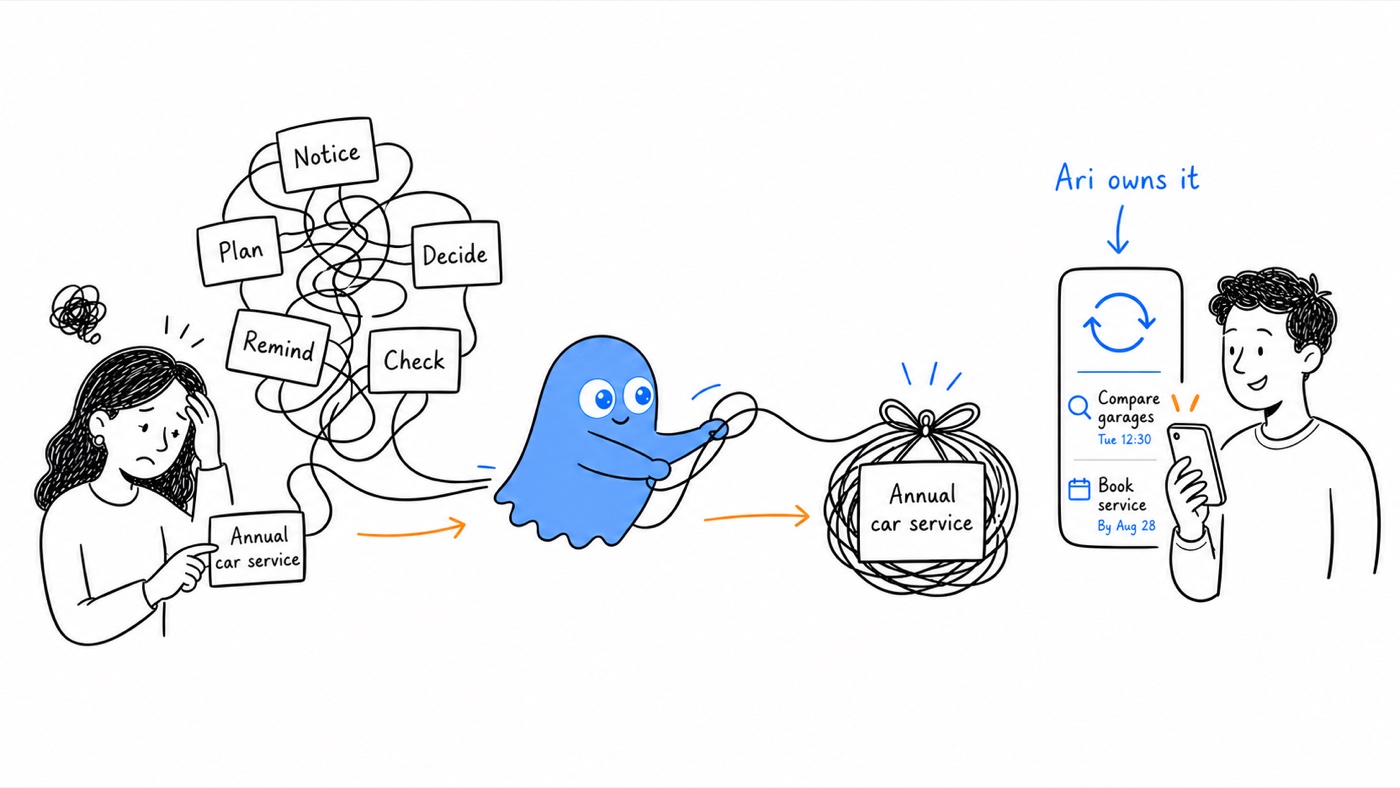
The other notices that the service is due, checks the week ahead, compares garages, chooses when the car can be unavailable, finds the documents, arranges transport, and checks whether the work was completed.
The visible appointment may be shared.
The thinking behind it may not be.
The short answer
The invisible mental load is the ongoing work of noticing, anticipating, planning, deciding, remembering, and monitoring what needs to happen.
In a relationship affected by ADHD, that load can collect around the partner who compensates for missed intentions, inconsistent follow-through, or planning difficulties. This can happen without either person deliberately choosing it.
ADHD does not automatically create an unequal relationship, and the non-ADHD partner is not always the person carrying more. The useful question is not “Who has the diagnosis?” It is “Who keeps the system running?”
Mental load is more than a long task list
Research on cognitive household labor offers a useful framework.
In a qualitative study of 35 couples, Allison Daminger described four parts of cognitive labor:
- Anticipating: noticing a future need or problem.
- Identifying: finding possible ways to meet it.
- Deciding: choosing what will happen.
- Monitoring: checking whether it worked.
Women in that study performed more of the cognitive labor overall, particularly anticipation and monitoring. The sample was limited and should not be treated as a rule for every couple. Read the study
A systematic review of 31 studies similarly found that women performed more household and childcare mental labor in the samples studied. It also reported associations with stress and lower life or relationship satisfaction, but those associations do not prove what causes distress in one relationship. Read the systematic review
How ADHD can enter the chain
ADHD may affect parts of daily functioning such as attention, working memory, planning, task initiation, inhibition, and remembering future intentions. The pattern and severity vary widely between people.
For example, Ari may happily agree to handle the annual car service.
Sneha may still be the person who:
- notices that the service deadline is approaching
- knows an upcoming trip means the car must be ready beforehand
- compares garages and available dates
- works out when the car can be unavailable
- sends the booking reminder
- checks whether the appointment was confirmed and completed
Ari completed the visible appointment.
Sneha carried the chain.
A systematic review of adult ADHD cognition found group-level differences across several domains while also demonstrating that ADHD cannot be reduced to one universal cognitive profile. Read the review
Research on adult ADHD and romantic relationships also reports elevated difficulties at the group level, but it does not prove that ADHD causes a particular division of household labor in every couple. Read the relationship review
The load becomes visible when you name the verbs
“Manage the children's appointments” is vague.
Write the actual verbs:
- notice when the next appointment is due
- find available clinics
- compare dates
- book the appointment
- enter it into the calendar
- complete the forms
- arrange transport
- remember the preparation instructions
- attend
- follow up on the result
Now the couple can see whether they are sharing a responsibility or only sharing the final action.
This matters at work too. “Prepare the client workshop” may hide research, scheduling, materials, reminders, approvals, travel, and follow-up.
Use the Shared screen to show the agreed plan
The MyOffload app cannot decide what a fair division looks like. It can make an agreed division easier to see.
With both partners' approval, Sneha can tap the mic and say:
Assign Ari the annual car service. On Tuesday at lunch, remind him to compare two garages and book the service before August 28.
MyOffload turns the useful parts into an owned task for Ari with the requested date, reminder, and context for review. Because Sneha assigned it, she automatically becomes a watcher. If the task still hides work, Ari can tap the Break Down button to add steps such as arranging transport and saving the confirmation.
The task appears on the Shared screen. Ari receives the reminder. Sneha can see whether the task is pending or complete without carrying the service deadline and follow-up in her own head.
The useful change is not simply that the reminder moved into an app.
The owner, timing, context, and status moved with it.
Do a mental-load audit without keeping score
Choose one area of shared life and ask:
Who notices?
Who usually sees that something will be needed?
Who plans?
Who finds the options, dates, information, or supplies?
Who decides?
Who makes the final call?
Who acts?
Who completes the visible step?
Who monitors?
Who checks whether it happened and repairs the gap if it did not?
The purpose is not to prove that one partner is bad. It is to reveal work that the current system makes hard to see.
For a practical example of turning a sincere intention into visible ownership, read My ADHD Partner Promises to Do Things but Forgets. If the imbalance has started to feel parental, read How to Stop Feeling Like a Parent to Your ADHD Partner.
Transfer one complete chain
Start with a contained responsibility.
Instead of “Ari books the car service when Sneha reminds him,” try:
Ari owns the annual car service. He tracks the due date, chooses the garage, books the slot, arranges transport, saves the confirmation, and adjusts the plan if the date changes.
If the task contains several steps, the owner can use the Break Down button in MyOffload. If the steps must fit around other work, the owner can use the Plan My Day button.
Sneha can remain a watcher if the task genuinely affects a shared plan. Watching should not require Sneha to drive the task forward.
Make room for different capacities
Fair does not always mean each person performs exactly half of every type of work.
One partner may handle finances while the other handles travel. One may cook while the other owns grocery planning. Capacity can also change during illness, deadlines, pregnancy, caregiving, burnout, or treatment changes.
The important questions are:
- Is the arrangement visible?
- Was it agreed rather than assumed?
- Can either partner ask to renegotiate it?
- Does one person still carry most of the monitoring?
- Are both partners responsible for repairing their own misses?
What MyOffload cannot solve
MyOffload can reduce manual capture, scheduling, reminders, and status conversations.
It cannot:
- determine what is fair
- make a partner participate
- treat ADHD
- replace relationship communication
- measure emotional labor
- repair a relationship that is controlling or unsafe
There is no peer-reviewed study showing that MyOffload reduces mental load or improves ADHD relationship outcomes.
Frequently asked questions
Is mental load the same as doing more chores?
No. Chores are visible actions. Mental load includes anticipating, planning, deciding, remembering, and monitoring the work around those actions.
Does the non-ADHD partner always carry more?
No. Couples differ, and either or both partners may have ADHD. Gender, work, health, caregiving, personality, and household structure can all shape the division.
Can sharing a calendar solve mental load?
It can help with visibility, but a calendar does not decide ownership. If one person still notices every need, creates every entry, and checks every result, the mental load has not fully moved.
How does MyOffload help?
It lets a natural spoken agreement become an owned task with context, timing, requested reminders, and shared status. This can reduce the amount one partner must manually remember and relay.
The bottom line
The invisible mental load is not only the number of things in your head.
It is the responsibility for keeping every unfinished chain alive.
Name the hidden verbs. Decide who owns the whole chain. Put the plan somewhere both partners can understand. Then let the responsible person receive the reminder and carry the follow-through.
Research behind this article
- Daminger, A. (2019). The Cognitive Dimension of Household Labor. American Sociological Review.
- Reich-Stiebert, N., Froehlich, L., & Voltmer, J.-B. (2023). Gendered mental labor: A systematic literature review on the cognitive dimension of unpaid work within the household and childcare. Sex Roles.
- Onandia-Hinchado, I., Pardo-Palenzuela, N., & Diaz-Orueta, U. (2021). Cognitive characterization of adult attention deficit hyperactivity disorder by domains: a systematic review. Journal of Neural Transmission.
- Wymbs, B. T., et al. (2021). Adult ADHD and romantic relationships: What we know and what we can do to help. Journal of Marital and Family Therapy.
Try MyOffload
Give the thought somewhere useful to go
Say the messy version. MyOffload keeps the context and turns the actionable parts into tasks, notes, and requested reminders for you to review.
Download MyOffload for iPhone