

“I keep researching, reorganising, and making better plans. Somehow I still have not started.”
Planning can be productive. It can also provide the feeling of progress without the discomfort of beginning. The distinction is not whether your system looks impressive. It is whether the plan changes what you do next.
This is not a diagnosis or a moral judgment. People delay for many reasons, including uncertainty, exhaustion, anxiety, perfectionism, competing demands, and tasks that are genuinely unclear.
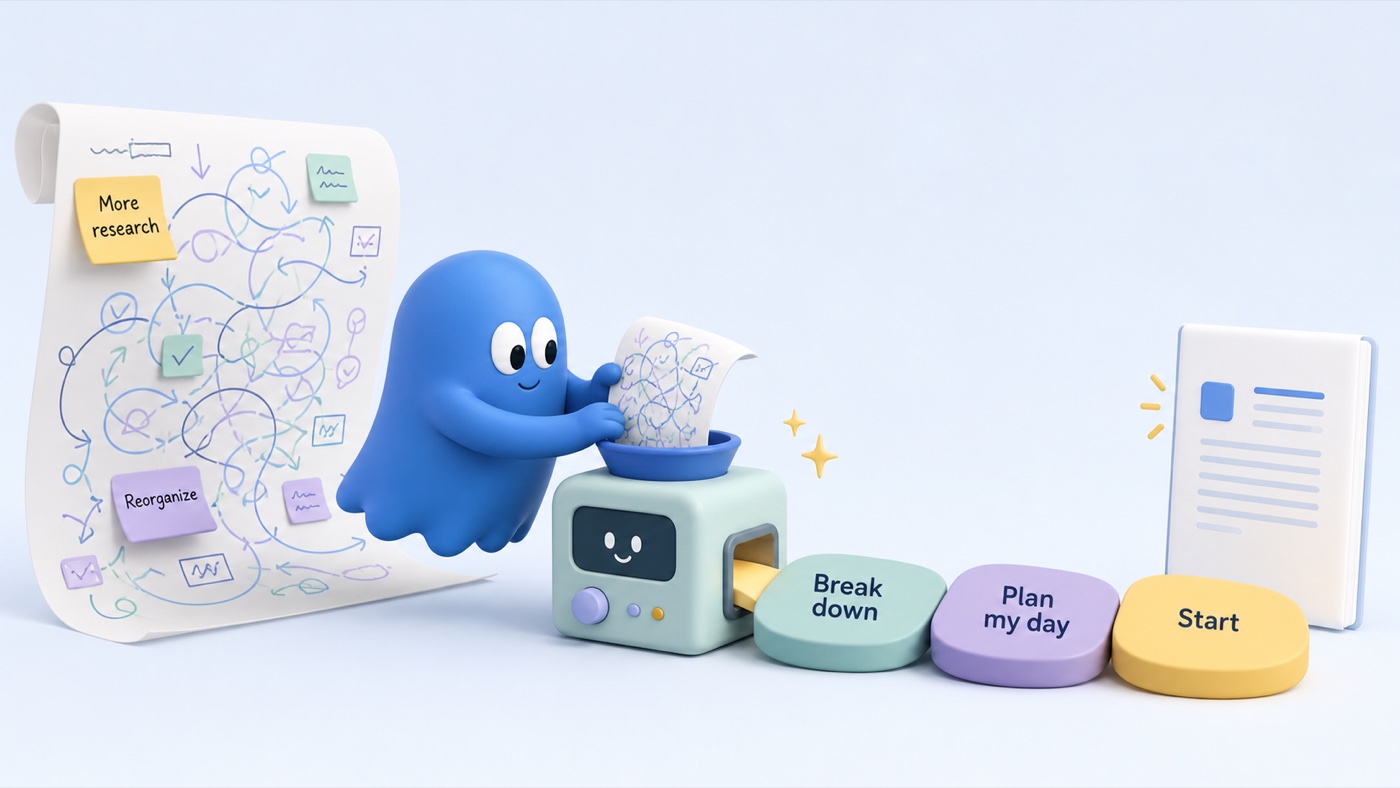
Useful planning ends in a visible action
A useful plan answers enough questions to begin:
- What am I trying to move forward?
- What is the next physical or visible action?
- When or where will I begin it?
Planning becomes avoidance when every answer creates another planning project: research more tools, redesign the board, rename every category, compare methods, or wait for a perfect uninterrupted day.
The warning sign is not “I enjoy planning.” It is “I keep improving the route without taking the first step.”
Procrastination is not simply laziness
A major meta-analytic review described procrastination as a self-regulation problem and found that task aversiveness, delay, low self-efficacy, impulsiveness, and weaker self-control were among its stronger correlates. More recent meta-analytic evidence shows a moderate association between procrastination and negative emotions such as anxiety, stress, and depression.
Those findings do not tell us which direction the relationship runs for one person. Feeling bad can make starting harder, and delay can create more distress. Calling yourself lazy explains very little and often adds shame to an already difficult task.
Use a capture boundary
Give planning a defined stopping point:
- Offload everything you think belongs to the project.
- Let the messy project become clear tasks.
- Make the first task small enough to start.
- Begin before adding more structure.
For example:
- “Build website” becomes “open the homepage file.”
- “Write article” becomes “write the first ugly paragraph.”
- “Plan launch” becomes “list the three decisions blocking launch.”
- “Sort finances” becomes “download the latest statement.”
If the next action still feels vague, make it smaller once. Then begin.
Let MyOffload turn the plan into a starting point
MyOffload helps before and after capture. Say the messy project once. It keeps the full thought and sorts the useful parts into tasks, notes, dates, and requested reminders for you to review.
If one task still feels too large, use Break Down to turn it into smaller steps. You do not have to work out the perfect sequence yourself.
If several tasks are competing for today, tap Plan My Day. MyOffload prioritizes and orders the day, keeps timed tasks in place, and gives you a clear starting point. Review anything important, then begin with the first step.
Try saying:
I want to launch the newsletter next Thursday. I still need the welcome email, landing page copy, test send, and final link check. Remind me to start tomorrow morning.
MyOffload can keep the context, identify the work, and create the requested reminder. You can break down the largest task, tap Plan My Day, and start without building another planning system.
The boundary still matters. Do not keep rearranging the plan after it is clear enough to act. The win is not a perfect system. The win is starting.
Turn intentions into cues
“Work on it tomorrow” still leaves tomorrow with a decision. A more useful statement links a cue to an action:
When I sit down with my morning coffee, I will open the document and write for five minutes.
These cue-action plans are called implementation intentions. A meta-analysis examining mental contrasting combined with implementation intentions found a small-to-medium positive effect on goal attainment across 21 studies, while also noting possible publication bias. Another meta-analysis found implementation intentions improved prospective memory.
That is not proof that one sentence defeats procrastination. It suggests that a concrete cue and response can be more useful than a broad intention.
Ask one question before planning more
Before doing more research or reorganising, ask:
- What decision will this new information change?
- What is the minimum information needed for that decision?
- Can I test a small version before knowing everything?
If you cannot name the decision, more research may be serving comfort rather than progress.
Use a simple rule: before you plan more, take one action that changes the work. Open the file. Send the question. Write the first line. Action gives you information that another round of planning cannot.
When the problem is not planning
Sometimes a task remains stuck because it is too large, under-resourced, unsafe, misaligned with your responsibilities, or dependent on someone else. Sometimes persistent difficulty starting tasks is connected to anxiety, depression, ADHD, burnout, sleep problems, or other health concerns.
An article cannot determine what applies to you. If avoidance is persistent, distressing, or substantially affecting daily life, a qualified professional can help you understand the pattern. MyOffload can make tasks clearer and easier to start. It is not a diagnosis or treatment.
The bottom line
Planning is useful when it reduces uncertainty enough to act. When the plan keeps expanding and the work remains untouched, use a shorter path:
Offload the mess. Break down what is too big. Tap Plan My Day. Start the first step.
Your first imperfect step contains information that another hour of planning cannot give you.
Research behind this article
- Steel, P. (2007). The nature of procrastination: a meta-analytic and theoretical review of quintessential self-regulatory failure. Psychological Bulletin.
- Nie, Y., et al. (2025). The association between procrastination and negative emotions in healthy individuals: a systematic review and meta-analysis. Frontiers in Psychiatry.
- Wang, G., Wang, Y., & Gai, X. (2021). A meta-analysis of the effects of mental contrasting with implementation intentions on goal attainment. Frontiers in Psychology.
- Chen, X.-J., et al. (2015). The effect of implementation intention on prospective memory: a systematic and meta-analytic review. Psychiatry Research.
Try MyOffload
Give the thought somewhere useful to go
Say the messy version. MyOffload keeps the context and turns the actionable parts into tasks, notes, and requested reminders for you to review.
Download MyOffload for iPhone